
Views: 0 Author: Site Editor Publish Time: 2026-10-09 Origin: Site


Joint failures in plastic piping systems cause severe operational downtime and expensive environmental cleanup. The integrity of an entire fluid handling network relies entirely on its weakest mechanical link: the elastomeric seal. Specifying rubber gaskets for PVC pipe connections requires exact engineering. Improper specification introduces immediate risks to the infrastructure. Incorrect elastomers degrade chemically when exposed to incompatible fluids. Wrong dimensional tolerances cause blowouts under standard operating pressures. Applying excessive torque to compress overly hard gasket materials inevitably cracks fragile plastic flanges.
Engineers and installers need a systematic framework for evaluating and selecting these sealing components. You must prioritize rigorous media compatibility checks to prevent chemical degradation. Exact dimensional standards ensure proper fitment without restricting flow. Understanding installation mechanics mitigates the risk of mechanical failure. We will break down the technical requirements for selecting and installing elastomeric seals in plastic piping networks.
Media Compatibility Dictates Material: EPDM is the industry standard for water, but aggressive chemicals or hydrocarbons require FKM (Viton), Nitrile, or PTFE-bonded elastomers to prevent degradation.
Dimensional Accuracy Prevents Blowouts: Matching gasket dimensions (Full-Face vs. Ring) to the specific PVC flange type and pipe schedule (40 vs. 80) is non-negotiable for pressure retention.
Durometer and Thickness Matter: PVC flanges require softer gaskets (typically 50-70 Shore A) or specialized ribbed profiles compared to metal flanges to achieve a seal without requiring torque levels that could crack the plastic.
Hardware and Alignment are Critical: The use of flat metal washers and proper alignment, especially with common Van Stone (loose ring) PVC flanges, is required to distribute bolt load evenly.
Compliance is Mandatory: Potable water systems require NSF/ANSI 61 certified rubber gaskets for PVC pipe to meet regulatory and safety standards.
Table of Contents
PVC flanged joints rely on rubber gasket compression to fill surface irregularities and prevent fluid leakage. Unlike metal piping, PVC and CPVC experience greater thermal expansion and contraction, which can affect gasket compression and sealing stability. Common gasket failures result from uneven bolt loads, improper material selection, thermal movement, or insufficient compression. Choosing a compatible, flexible gasket and following proper installation procedures helps maintain reliable, long-term sealing performance.
Chemical Attack: Incompatible fluids attack the polymer chains of the rubber. This causes the material to swell, embrittle, or dissolve entirely. A swollen seal extrudes past the outer diameter of the flange. An embrittled seal loses its elasticity and cracks under normal system vibration.
Extrusion and Blowout: Internal hydrostatic pressure forces the rubber out of the joint. This occurs when installers use an elastomer with a durometer that is too soft for the system pressure, or when the component is sized incorrectly for the flange face.
Flange Breakage: Plastic flanges possess low tensile strength. Installers frequently over-torque the bolts in an attempt to compress a material that is too hard or too thick. This excessive clamping force bends the plastic flange over the seal, snapping the PVC hub.
Thermal Cycling Fatigue: Continuous heating and cooling cycles cause the pipe to grow and shrink. If the elastomer takes a permanent compression set and loses its rebound resilience, it will fail to maintain contact with the flange face during the contraction phase of the thermal cycle.
Selecting the correct material begins with a strict evaluation of the fluid media. You must match the specific rubber compound to the chemical makeup of the fluid. No single elastomer handles every industrial application. Relying on generic materials for specialized chemical lines guarantees premature failure.
EPDM serves as the baseline standard for most municipal and commercial plumbing applications. It provides exceptional resistance to weathering, ozone, and ultraviolet light exposure.
Best for: Potable water distribution, wastewater treatment, HVAC chilled water lines, and systems handling dilute acids or alkalis.
Limitations: EPDM degrades rapidly when exposed to petroleum-based oils, lubricants, or hydrocarbon solvents. Never install EPDM in diesel fuel lines, compressed air systems with oil carryover, or oil recovery networks. The material will swell massively and fail within days.
Nitrile fills the operational gap where EPDM fails. It offers strong resistance to petroleum products and mineral oils.
Best for: Systems transporting lubricating oils, diesel fuels, and petroleum-based hydraulic fluids.
Limitations: Nitrile exhibits poor resistance to ozone and direct sunlight. It also degrades rapidly when exposed to aggressive solvents like ketones, esters, and strong oxidizing acids.
FKM handles extreme chemical environments where standard elastomers break down. It maintains molecular stability under severe chemical attack.
Best for: Aggressive chemical dosing lines, halogenated hydrocarbons, concentrated acids, and higher temperature industrial processing applications.
Trade-offs: FKM is significantly stiffer than EPDM. You must ensure the plastic flange can handle the required torque to compress an FKM seal.
Solid PTFE (Teflon) offers near-universal chemical resistance. However, solid PTFE is incredibly hard and lacks elasticity. You cannot compress a solid PTFE sheet against a plastic flange without cracking the PVC. A hybrid solution resolves this mechanical conflict.
Best for: Highly aggressive or mixed chemical waste streams. The PTFE envelope faces the fluid and provides the chemical barrier. The EPDM core provides the necessary compressibility and rebound resilience to seal against fragile plastic flanges at low torque values.
You must align the elastomer's thermal limits with the operational thresholds of the piping material. Standard Schedule 80 PVC handles a maximum operating temperature of 140°F. CPVC pushes this limit to 200°F. Ensure your chosen elastomer maintains its physical properties well above these thresholds. While most standard industrial elastomers easily exceed 200°F, verifying the continuous operating temperature prevents premature thermal hardening of the rubber.
Elastomer Chemical Compatibility and Thermal Limits | |||
Elastomer Material | Primary Application | Incompatible Media | Max Continuous Temp (°F) |
|---|---|---|---|
EPDM | Water, Wastewater, Dilute Acids | Petroleum Oils, Hydrocarbons | 250°F |
Nitrile (Buna-N) | Oils, Fuels, Petroleum Fluids | Ozone, Ketones, Strong Acids | 212°F |
FKM (Viton) | Concentrated Acids, Halogens | Ketones, Steam, Hot Amines | 400°F |
PTFE-Bonded EPDM | Mixed Chemical Waste, Solvents | Liquid Alkali Metals | 250°F |
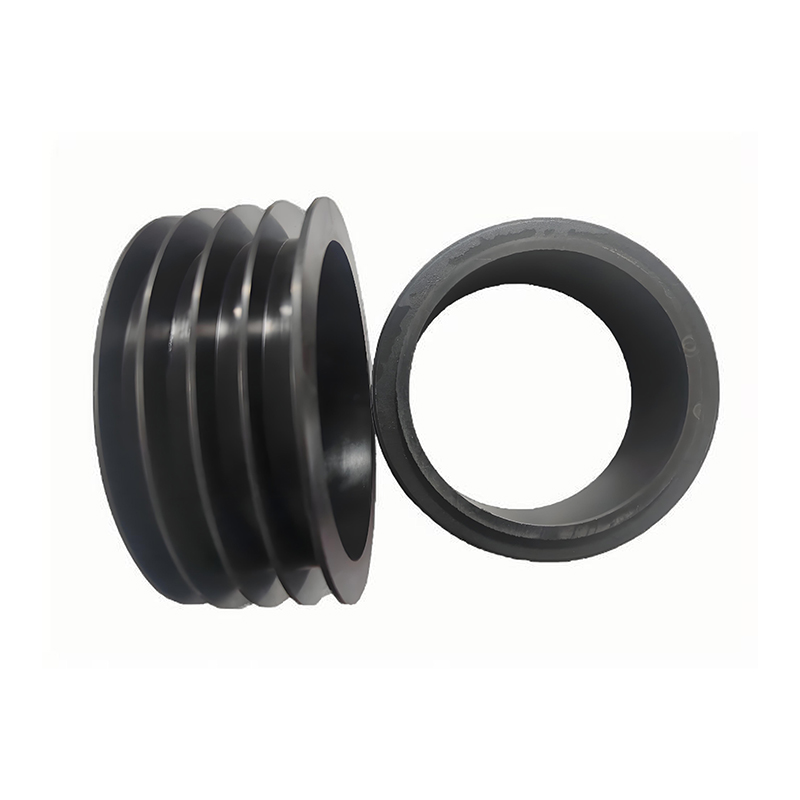
Geometric requirements dictate the success of a secure flanged joint. You cannot force an incorrectly sized component to work through excessive bolt torque. Proper specification of Rubber Gaskets for PVC Pipe prevents mechanical stress on the piping infrastructure.
Full-face gaskets cover the entire flange surface, including bolt holes, helping distribute clamping pressure evenly and reduce the risk of PVC flange cracking. Ring gaskets sit inside the bolt circle and may create uneven loading on unsupported flat-face plastic flanges. Full-face designs are generally preferred for standard flat-face PVC connections, subject to manufacturer specifications.

Flat rubber gaskets require sufficient compression to seal surface irregularities, while ribbed or bulb-ring gaskets concentrate sealing pressure along raised profiles. These specialized designs can achieve reliable sealing with lower bolt loads, making them suitable for plastic flanges where excessive tightening may cause damage.
PVC flange gasket dimensions must match the applicable flange standards, including inner diameter, outer diameter, bolt circle diameter, and bolt hole spacing. Verify compatibility with relevant ANSI/ASME dimensions and PVC flange manufacturer specifications. Accurate sizing ensures proper alignment and prevents installation damage or leakage.
Gasket thickness and hardness affect compression and sealing performance in PVC flange connections. A thickness of 1/8 inch (3.2 mm) and hardness of 50–70 Shore A may serve as initial selection references for certain applications. Softer gaskets generally require less compression force, while excessively thick or hard materials can increase extrusion risks or stress on plastic flanges. Final specifications should follow manufacturer recommendations.
Dimensional and Profile Comparison for Plastic Flanges | |||
Gasket Type | Flange Compatibility | Torque Requirement | Risk of Flange Cracking |
|---|---|---|---|
Standard Full-Face (Flat) | Flat-Face PVC | Moderate to High | Low (if torqued correctly) |
Ribbed Full-Face | Flat-Face PVC | Low | Very Low |
Ring Gasket (IBC) | Raised-Face Only | High | High (Do not use on flat-face) |
PTFE-Bonded EPDM | Flat-Face PVC | Moderate | Low |
You must align component capabilities with actual system demands. Over-specifying wastes resources, while under-specifying invites catastrophic failure. Evaluate the hydraulic realities of your network before finalizing specifications.
Specifying components for Schedule 40 versus Schedule 80 pipe requires attention to internal dimensions. Schedule 80 pipe has a thicker wall to handle higher pressures. This thicker wall means the inner diameter (ID) is smaller than that of Schedule 40 pipe.
If you use a standard Schedule 40 seal on a Schedule 80 system, the inner edge of the elastomer will protrude into the fluid path. This protrusion restricts flow and creates turbulence. Turbulence leads to cavitation, which causes premature wear on downstream valves, pumps, and instrumentation. Always verify the inner diameter clearance matches the specific pipe schedule you are installing.
Ensure the pressure rating of the elastomer exceeds the maximum operating pressure of the system. More importantly, account for surge pressures. Water hammer occurs when valves close quickly or pumps shut down abruptly. The kinetic energy of the moving fluid converts instantly to pressure energy. This creates a pressure spike that travels through the fluid at the speed of sound. A system operating at 100 PSI can easily experience micro-second spikes exceeding 300 PSI during a water hammer event. The seal must withstand these temporary spikes without extruding from the joint or losing its compressive set.
Secure your piping infrastructure by implementing strict specification protocols for every flanged connection. Relying on guesswork or generic components leads directly to system failure, environmental hazards, and costly downtime.
Cross-reference your specific fluid media and maximum operating temperature against an elastomer chemical compatibility chart to select the correct compound.
Measure the inner diameter of your pipe schedule to ensure the selected component will not protrude into the flow path and cause turbulence.
Specify ribbed or bulb-ring profiles for all plastic flange connections to minimize the required bolt torque and protect the PVC from cracking.
Procure a calibrated torque wrench and mandate the use of flat metal washers and a star-pattern tightening sequence for all field installations.
A: EPDM is the optimal choice for potable water applications. It offers excellent resistance to water and chloramines. However, the material must carry NSF/ANSI 61 certification. This certification guarantees the elastomer will not leach harmful chemicals or contaminants into the drinking water supply.
A: No. Using a ring gasket on a flat-face plastic flange creates a severe bending moment. When you tighten the bolts, the outer edges of the flange pull together over the void. This stress almost always cracks or breaks the brittle PVC hub. Always use full-face designs.
A: Yes. Ribbed or bulb-ring designs concentrate the clamping force onto a smaller surface area. This allows you to achieve a leak-free seal using significantly less bolt torque. Lower torque requirements drastically reduce the risk of cracking the fragile plastic flanges during installation.
A: Torque requirements are very low compared to metal piping. Depending on the pipe diameter, torque typically ranges from 15 to 30 ft-lbs. You must use a calibrated torque wrench and follow a star-pattern sequence. Always use flat metal washers to distribute the load and prevent plastic damage.
A: The industry standard thickness is 1/8 inch for most standard applications. This thickness provides adequate material to fill microscopic flange imperfections and compress properly without requiring excessive bolt load. Thicker materials may extrude under pressure, while thinner materials might not seal effectively.
A: Failures typically stem from four main causes: chemical incompatibility degrading the elastomer, over-torquing bolts which cracks the plastic flange, failing to use load-distributing metal washers, and using incorrect dimensional sizing leading to blowouts.
A: Yes, in many cases. While the outer bolt circle remains identical for a given pipe size, Schedule 80 pipe has a thicker wall and a smaller inner diameter. If you use a standard Schedule 40 seal on Schedule 80 pipe, the material may protrude into the flow path, causing turbulence.


