
Views: 0 Author: Site Editor Publish Time: 2026-10-09 Origin: Site


Fluid containment failures on oil reservoir covers shut down machinery instantly. Whether you operate heavy industrial hydraulics, aerospace actuators, or automotive drivetrains, a leaking cover means catastrophic fluid loss, immediate environmental compliance violations, and unplanned downtime. You face a strict mechanical challenge. You must specify a sealing material that maintains long-term integrity under continuous exposure to petroleum-based fluids, fuels, and industrial greases. The joint must survive fluctuating temperatures and constant mechanical stress without relaxing. Nitrile Butadiene Rubber (NBR), or Buna-N, is the industry-standard baseline for oil containment. But successful deployment requires more than cutting a generic rubber sheet. It demands rigorous material grading and precise joint design validation. You have to match the elastomer formulation to the operating environment to prevent premature failure. Proper specification ensures the seal maintains system pressure, resists chemical degradation, and accommodates thermal expansion over thousands of operating hours.
Acrylonitrile (ACN) Content Dictates Performance: The ratio of ACN in NBR gaskets directly controls the trade-off between petroleum resistance and low-temperature flexibility.
Engineered Swell is a Feature, Not a Flaw: Controlled volume swell in NBR gaskets for oil reservoir covers enhances the sealing force, provided the joint design accommodates the expansion.
Compression Set is the Primary Failure Mode: Sustained load and thermal cycling require strict adherence to bolt torque specifications and flange surface finish tolerances to prevent elastomer relaxation.
Clear Escalation Thresholds: NBR is optimal for standard hydraulic fluids, lubricating oils, and greases up to 100°C (212°F); applications exceeding these parameters or utilizing aggressive synthetic additives require escalation to FKM, Neoprene, or specialized compounds.
Table of Contents
Nitrile rubber possesses a unique molecular structure offering exceptional resistance to aliphatic hydrocarbons. This makes it highly compatible with mineral oils, standard hydraulic fluids, and common industrial greases. The polymer chain repels non-polar petroleum fluids. This prevents the rapid degradation seen in natural rubber or EPDM when exposed to oil. Engineers specify NBR gaskets for oil reservoir covers because the material maintains its structural integrity across diverse lubrication environments.
Empirical testing validates this chemical resistance. Standardized protocols, such as ASTM D471, measure fluid compatibility through prolonged immersion. A successful NBR compound typically demonstrates a volume change of less than 15% after a 1,000-hour immersion test in standard reference oils at elevated temperatures. Tensile strength retention must remain high. Hardness changes should not exceed 10 durometer points. Meeting these empirical criteria ensures the gasket will not dissolve, fracture, or lose its sealing capability during continuous operation.
Field applications demand strict verification of the exact fluid type. While NBR handles standard ISO 32, 46, and 68 hydraulic oils effortlessly, introducing specialized aviation fluids or aggressive cleaning solvents changes the compatibility matrix. You must evaluate the base stock of the lubricant. Mineral-based stocks align perfectly with NBR. Synthetic stocks require a deeper chemical review to ensure the elastomer will not break down under pressure.
Fluid Type | Compatibility Rating | Expected Volume Swell | Engineering Notes |
|---|---|---|---|
Standard Mineral Oil | Excellent | 2% to 8% | Baseline application for standard NBR compounds. |
Diesel Fuel | Good to Excellent | 5% to 12% | Requires medium to high ACN content for stability. |
Phosphate Ester (Skydrol) | Severe Failure | >100% | Do not use NBR. Material will dissolve rapidly. |
Water/Glycol Mixtures | Good | 0% to 5% | Monitor temperature limits closely to prevent hardening. |
Controlled oil swelling can improve NBR gasket sealing performance by slightly expanding the rubber to maintain contact pressure and fill minor surface gaps. Moderate swelling may help compensate for vibration and compression loss, while excessive swelling can cause softening, deformation, and leakage. Proper material selection ensures swelling remains within acceptable limits without compromising gasket durability.
The performance of an NBR gasket depends entirely on its Acrylonitrile (ACN) content. ACN levels typically range from 18% to 50%. This percentage dictates a strict trade-off between oil resistance and low-temperature flexibility. Low ACN formulations (18% to 24%) provide excellent flexibility in freezing conditions, remaining pliable down to -40°C. However, they offer lower resistance to petroleum fluids and will swell significantly more in oil.
High ACN formulations (35% to 50%) deliver superior resistance to oils, fuels, and hydrocarbon solvents. They exhibit minimal swell and retain high tensile strength in harsh chemical environments. The drawback is poor low-temperature performance; high ACN compounds become brittle and lose their sealing ability near -15°C. Selection frameworks must align with the operating environment. Outdoor mobile equipment operating in winter climates requires medium-low ACN grades. Conversely, climate-controlled industrial hydraulics demand high ACN grades for maximum fluid resistance.
ACN Grade | ACN Percentage | Low Temp Limit | Oil Resistance | Typical Application |
|---|---|---|---|---|
Low ACN | 18% - 24% | -40°C | Fair | Arctic mobile hydraulics, outdoor winter equipment. |
Medium ACN | 28% - 33% | -30°C | Good | General industrial reservoirs, standard gearboxes. |
High ACN | 38% - 50% | -15°C | Excellent | Aviation fuel systems, high-concentration hydrocarbon containment. |
Commercial-grade NBR is cost-effective but may offer less consistent oil resistance, durability, and compression set performance, depending on its formulation. Premium-grade NBR uses higher-quality polymers and optimized curing systems to improve sealing stability, elasticity, and long-term reliability. Premium grades are better suited for demanding automotive, aerospace, and industrial applications requiring consistent performance.
NBR provides reliable oil resistance and typically operates between -40°C and 100°C, depending on the grade. Neoprene offers better weathering and ozone resistance, while FKM (Viton) handles higher temperatures and aggressive oils. Silicone provides excellent flexibility across a wide temperature range but has lower tear resistance. Material selection should depend on temperature, chemical exposure, and sealing requirements.
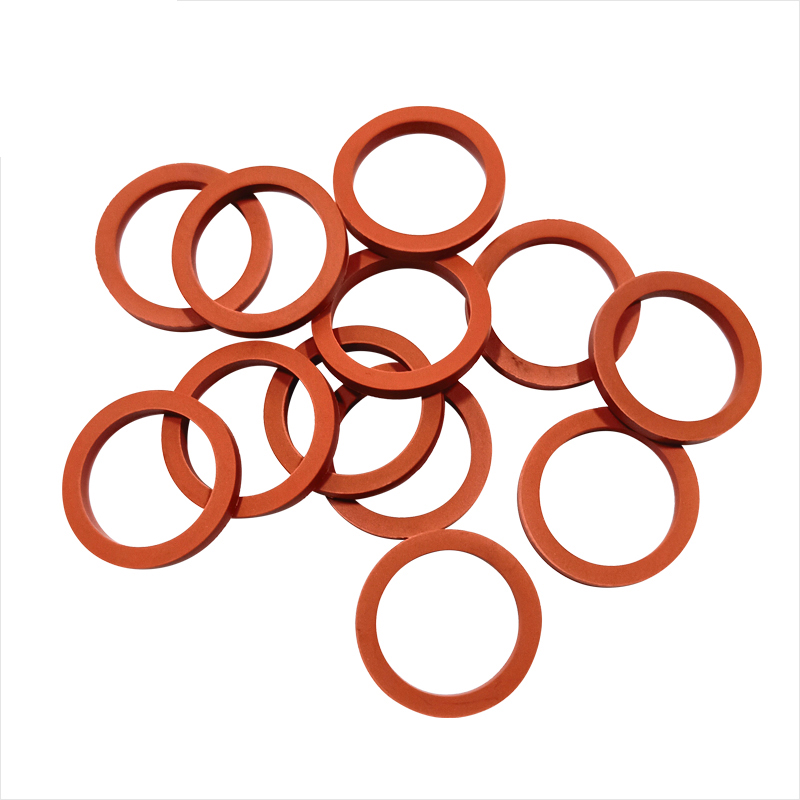
Flange surface finish and flatness directly affect gasket sealing performance. Rough surfaces can create leak paths, while excessively smooth surfaces may reduce grip in certain applications. NBR Gaskets must match the flange finish and operating conditions. Warped or flexible covers may require softer, thicker gaskets, while rigid machined surfaces can accommodate thinner designs.
Proper bolt load and even compression are essential for preventing gasket failure. Excessive pressure and high temperatures can cause compression set, reducing the gasket's ability to recover and maintain a seal. Use calibrated torque wrenches and a cross-pattern tightening sequence to distribute pressure evenly and minimize premature wear.
Die-cut NBR gaskets are cost-effective solutions for flat-face flanges, while custom molded NBR gaskets fit into grooves for improved positioning and extrusion resistance. Groove dimensions must allow sufficient space for compression, thermal expansion, and material swelling. Proper groove design prevents overfilling, extrusion, and premature seal failure.
A: Standard NBR gaskets operate reliably up to a continuous temperature of 100°C (212°F). They can withstand intermittent temperature spikes up to 120°C (248°F). Prolonged exposure above these thresholds accelerates compression set, causing the rubber to harden, lose its elasticity, and eventually leak. High-heat applications require escalation to FKM or HNBR.
A: ACN content dictates the balance between chemical resistance and cold flexibility. Higher ACN levels (35-50%) provide superior resistance to petroleum oils and fuels but cause the rubber to become brittle at low temperatures. Lower ACN levels (18-24%) offer excellent flexibility in freezing conditions but exhibit higher volume swell when exposed to oils.
A: Both materials resist oil, but NBR offers significantly superior resistance to petroleum-based fluids, fuels, and hydraulic oils. Neoprene provides moderate oil resistance but excels in weathering, ozone, and UV resistance. NBR is preferred for internal or enclosed oil containment, while Neoprene is better for exterior applications facing environmental exposure.
A: NBR is compatible with many standard synthetic oils and fuels. However, highly additized synthetics, extreme pressure (EP) gear oils, and ester-based synthetic lubricants can chemically attack standard Nitrile rubber. These aggressive fluids extract plasticizers, causing shrinkage and embrittlement. Always verify compatibility with the specific fluid additive package.
A: Primary failure modes include compression set from sustained thermal cycling, over-compression leading to physical extrusion, and ozone cracking from environmental exposure. Chemical attack from incompatible oil additives like active sulfur or high amines also causes rapid hardening, shrinkage, and loss of sealing force.
A: Standard industry practice targets a compression range of 10% to 30% of the gasket's original thickness. The exact percentage depends on the material's durometer and the system's internal pressure. Compressing the rubber beyond 30% risks fracturing the polymer matrix and causing permanent extrusion.
A: Prevent extrusion by utilizing proper groove design that limits volume fill to 75-85%, allowing room for thermal expansion. Selecting a higher durometer NBR compound increases extrusion resistance. For flat-face flanges, integrating metal compression limiters prevents the bolts from crushing and squeezing the rubber out of the joint.


