
Views: 0 Author: Site Editor Publish Time: 2026-10-08 Origin: Site


Seal failure carries severe operational consequences across industrial applications. Fluid leakage causes immediate environmental hazards and safety risks on the plant floor. Premature wear forces unplanned downtime on critical equipment, draining project budgets rapidly. Engineers and procurement teams often use sealing terms interchangeably, grouping distinct components under the broad category of "seals." This creates a core engineering problem. Selecting the wrong sealing mechanism for a specific joint design leads to catastrophic failure under pressure or unnecessary machining expenses during manufacturing. We must evaluate both sealing methods carefully through a strict engineering framework. We analyze mechanical behavior, predictable deformation, mating surface geometry, and hardware constraints. We also consider the specific operational environment. Sealing compressed air requires different parameters than sealing hydraulic liquid. Understanding the mechanics behind a rubber gasket vs o ring ensures reliable joint design and long-term equipment performance.
Categorical Distinction: "Seal" is the overarching category. All O-rings are technically a subset of gaskets, but not all gaskets are O-rings. A rubber gasket generally refers to a flat, die-cut, or molded seal for complex profiles, while an O-ring is a specific torus-shaped elastomer (sometimes referred to as a packing joint) requiring a machined groove.
Pressure Dynamics: O-rings utilize system pressure to apply a predictable deformation, increasing contact stress and sealing force, making them superior for high-pressure fluid power and pneumatic systems.
Surface Forgiveness: A standard rubber gasket is more forgiving of uneven flange surfaces and broader tolerances, whereas O-rings require precise groove and gland depth machining to create a tight mating surface.
Application Scope: O-rings are highly viable in both static and dynamic (reciprocating/rotary) applications; flat rubber gaskets are strictly suited for static assemblies.
Table of Contents
A rubber gasket is a flexible sealing component used primarily between stationary mating surfaces to prevent air, gas, or liquid leakage. Available in flat, ring, and custom shapes, rubber gaskets rely on bolt or clamp compression to fill surface irregularities and create a tight seal. Gasket thickness, material hardness, and bolt load directly affect sealing performance, with proper selection helping prevent deformation, extrusion, and leakage.

O-rings are circular elastomeric seals with a round cross-section, typically installed in precisely machined grooves. Initial compression creates a seal, while internal pressure pushes the O-ring against the groove surfaces to maintain sealing contact. Proper groove dimensions, compression ratio, and material selection are essential to prevent extrusion, excessive deformation, and leakage in static or dynamic applications.
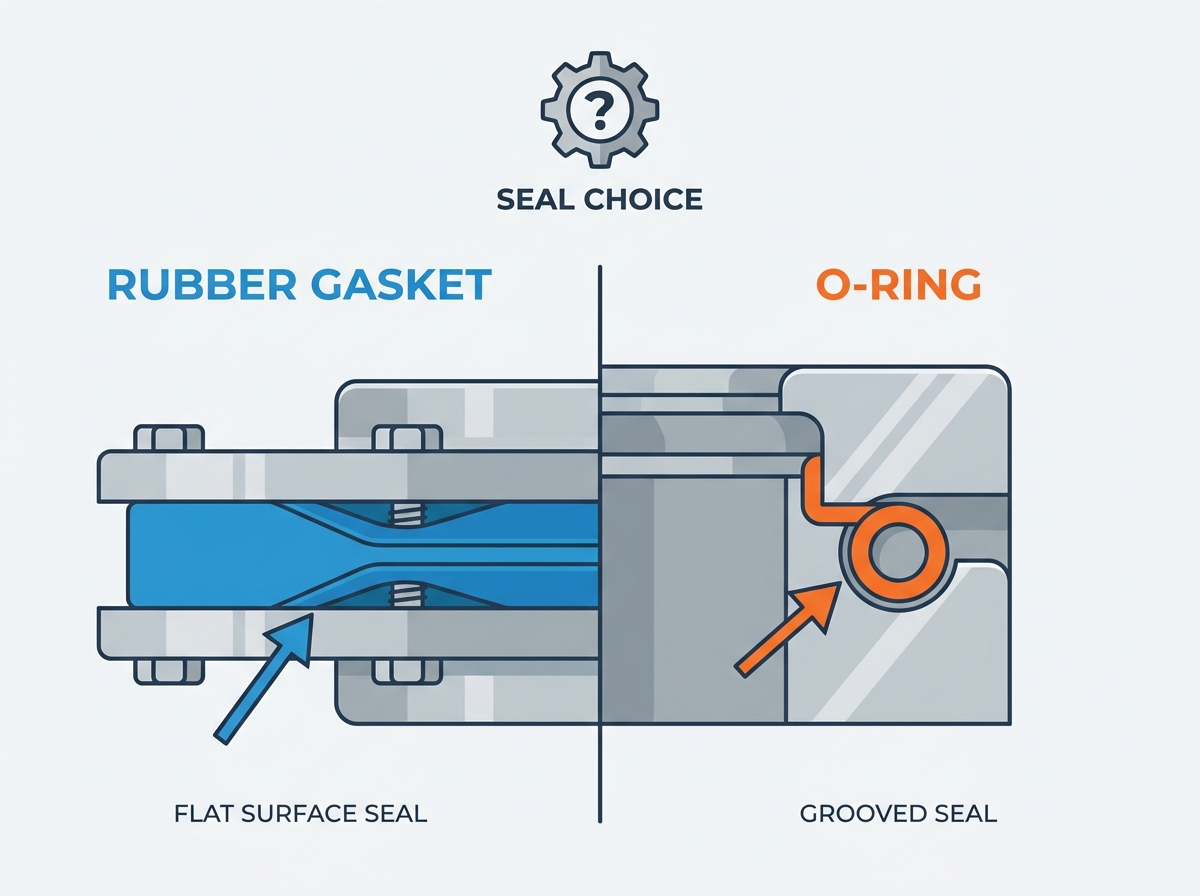
O-rings are commonly used in high-pressure hydraulic and pneumatic systems, where proper groove design and backup rings help prevent extrusion. Flat rubber gaskets are generally suited to static flange connections but may require additional reinforcement for high-pressure applications. Gas sealing demands greater attention to permeability, while liquid sealing depends on fluid compatibility, pressure, and gasket compression.
O-rings are suitable for both static and dynamic sealing, including pistons, cylinders, and rotating shafts, when properly designed and lubricated. Flat rubber gaskets are primarily used in static applications such as equipment housings, oil pans, and gearbox covers. Seal selection depends on movement, friction, sealing geometry, and maintenance requirements.
O-rings require precisely machined grooves, controlled compression, and suitable surface finishes to prevent leakage, extrusion, and premature wear. Dynamic applications generally demand tighter tolerances and smoother surfaces. Flat rubber gaskets can accommodate certain surface irregularities without dedicated grooves, reducing machining complexity. Proper surface preparation and dimensional accuracy remain essential for reliable sealing.
Common compounds perform differently based on their physical shape. Nitrile (NBR), Silicone, FKM (Viton), and EPDM are standard industrial materials. Molding them into a circular cross-section changes their performance characteristics. Die-cutting them as a flat seal alters their mechanical behavior. Cross-sectional thickness impacts chemical permeation rates directly. Thicker profiles resist thermal degradation better over time. Thin flat profiles may degrade faster in aggressive chemical environments.
Elastomer Material | Temperature Range | Chemical Resistance | Best Application |
|---|---|---|---|
Nitrile (NBR) | -30°F to 250°F | Petroleum oils, water, hydraulic fluids | General industrial hydraulics |
Silicone (VMQ) | -65°F to 450°F | Ozone, UV, extreme temperatures | Static high-heat environments |
FKM (Viton) | -15°F to 400°F | Acids, fuels, harsh chemicals | Chemical processing equipment |
EPDM | -60°F to 300°F | Steam, weather, brake fluids | Outdoor and steam systems |
Neoprene (CR) | -40°F to 250°F | Refrigerants, mild acids, weathering | HVAC and refrigeration systems |
Compression set affects a rubber seal's ability to recover after prolonged compression, directly influencing sealing performance and service life. Softer elastomers conform better to uneven surfaces but may be more prone to extrusion, while harder materials offer greater pressure resistance. Proper material hardness, groove dimensions, and thermal expansion allowances help prevent deformation, leakage, and premature seal failure.
O-rings are generally cost-effective and widely available, but they require precisely machined grooves that increase component manufacturing costs. Flat rubber gaskets use simpler mating surfaces but may involve higher material waste and custom cutting or molding expenses. The most economical option depends on seal geometry, production volume, tooling requirements, and machining complexity.
O-rings are typically easier to replace but require careful installation to prevent twisting, pinching, or cutting. Compatible lubrication and proper groove design help reduce assembly damage. Flat gaskets may require more extensive surface cleaning and removal of old sealing material during replacement. Selecting the appropriate seal design helps simplify maintenance, reduce installation errors, and minimize equipment downtime.
Choosing the correct sealing method requires strict alignment with the joint geometry, pressure requirements, and manufacturing capabilities. Air and liquid behave differently under pressure, and your hardware must accommodate those physical realities. Follow these actionable steps to finalize your joint design:
Review your CAD models to verify if precision groove machining is feasible for your specific housing geometry.
Calculate the maximum extrusion gap in your assembly and specify backup rings if operating above 1,500 PSI.
Specify exact surface roughness (Ra) values on your manufacturing drawings to prevent abrasion.
Consult with a polymer engineer to match the elastomer compound and durometer to your chemical media and temperature range.
Request prototype samples and conduct physical pressure testing to verify compression ratios before full production.
A: "Seal" is the broad category for any device preventing leakage. A rubber gasket is typically a flat, custom-shaped seal used between two static flanges. An O-ring is a specific torus-shaped seal designed to sit inside a machined groove, functioning in both static and dynamic applications.
A: No, they are not directly interchangeable. Replacing a flat seal with a circular one requires machining a specific groove into one of the mating surfaces. Without the groove, the circular seal will crush, extrude, or blow out under pressure.
A: O-rings are vastly superior for high-pressure hydraulics. They utilize the system fluid pressure to increase their sealing force against the groove walls. When paired with backup rings, they can withstand extreme hydraulic pressures without extruding.
A: Yes, technically speaking. All O-rings are a subset of gaskets because they seal the space between two mating surfaces. However, in engineering terminology, the terms are separated to distinguish between flat flange seals and grooved torus seals.
A: The standard compression rate varies by material durometer and thickness. Generally, solid elastomers require 10% to 20% compression to achieve a proper seal. Sponge or foam materials may require up to 50% compression to close their internal cellular structure.
A: Groove depth is determined by the desired squeeze percentage. Static seals typically require a 15% to 30% squeeze to ensure a tight fit. Dynamic seals require a lower squeeze, usually 8% to 16%, to reduce friction and prevent premature wear during movement.


