
Views: 0 Author: Site Editor Publish Time: 2026-11-26 Origin: Site


Rubber gasket extrusion occurs when gasket material is forced into an unintended clearance or displaced beyond its intended sealing position. Depending on the joint, this can result from assembly compression, internal pressure, movement, or changes in the rubber itself.
A visible edge bulge does not automatically mean the gasket has failed. Rubber normally changes shape when compressed. The concern is whether the displacement exceeds the design allowance, damages the seal, restricts a passage, or reduces sealing contact.
Before choosing a harder compound or increasing bolt torque, inspect the complete joint. The failed gasket is evidence, but it is only one part of the investigation.
Table of Contents
Solid rubber is approximately incompressible under typical gasket-loading conditions. When compressed between surfaces, it mainly changes shape and expands into available space.
Some lateral bulging may therefore be expected in an unconfined flat gasket. Its acceptability depends on the profile, permitted compression, available clearance, and equipment requirements.
Warning signs include torn edges, material entering an unintended gap, significant loss of gasket position, or intrusion into a flow passage.
Compare the observed shape with the drawing and, where available, a correctly assembled reference joint.
Squeeze-out can occur while the joint is tightened, before operating pressure is applied.
Possible contributors include excessive closure, an oversized gasket, poor retention, uneven tightening, or an unapproved surface treatment that changes friction.
A localized rolled or pinched section may instead indicate that the gasket was out of position when the cover closed. Record when the displacement first appeared rather than identifying the cause from appearance alone.
In a pressure-containing joint, rubber may be driven into a clearance toward the lower-pressure side.
Pressure cycling and movement of the mating parts can repeatedly trap and damage the displaced material. In confined seals such as O-rings, this may produce a chewed edge commonly described as nibbling.
These observations are useful diagnostic clues. However, O-ring clearance charts should not be applied directly to an unconfined flat gasket with different geometry and support.
Here, extrusion describes a failure mechanism. It is different from extrusion manufacturing, where rubber is formed into a continuous profile.
A gasket needs room to change shape during closure. If the assembled gap is too small or a groove contains too much rubber, material may be displaced into adjacent clearances.
Check free gasket dimensions, groove dimensions, assembled gap, and tolerances. Include potential swelling and thermal changes.
For a simple flat section:
Compression (%) = (free thickness − assembled gap) ÷ free thickness × 100
Use the approved compression range for the specific compound and profile. There is no single percentage suitable for every rubber gasket.
Pressure extrusion becomes more likely when the seal faces a clearance it cannot withstand under the operating conditions.
The relevant gap may be larger in service than during inspection. Pressure, temperature, cover bending, or movement can change it.
Inspect flange stiffness, fastener spacing, wear, alignment, and support near the damaged area. A harder gasket cannot reliably compensate for uncontrolled joint opening.
A seal may operate satisfactorily at normal pressure but experience damage during a transient event.
Review startup, shutdown, valve operation, pressure reversals, and other conditions relevant to the equipment. Where necessary, use suitable monitoring to investigate peaks that routine readings may miss.
Confirm temperature at the joint as well. The rubber’s mechanical response under operating conditions may differ from its room-temperature condition.
Exposure to an incompatible medium or cleaning chemical can change gasket dimensions and mechanical properties.
Swelling can increase the volume occupying a groove. Softening or loss of strength may make displacement easier. Other forms of deterioration can produce cracking or tearing that resembles extrusion damage.
Review the full exposure history, including cleaners, assembly lubricants, and accidental contamination.
Lixu Rubber’s rubber gaskets and seals include different material options. Confirm the proposed compound against the actual medium and operating conditions.
Wrong thickness, inaccurate cutting, insufficient sealing width, or misplaced locating features can leave part of the gasket unsupported.
Stretching a seal into position may also change its cross-section or pull it away from corners. An oversized gasket can buckle before the joint is fully closed.
Inspect the supplied part against the drawing and verify that it fits naturally in its intended location.
Isolate, depressurize, drain, and cool the equipment as required by its maintenance procedure before opening the joint.
Photograph the gasket position and visible damage before removal. Mark its orientation, pressure side, bolt locations, and the location of leakage.
Keep the failed gasket where practical. Avoid stretching it or using an unapproved solvent that could change its condition.
Record the operating duration and whether the problem appeared during assembly, initial testing, or later service.
Compare the installed part with the approved dimensions. Check thickness at several suitable locations and inspect grooves, stops, sealing lands, and clearances.
Measurement methods should suit soft rubber; excessive measuring force can distort the result.
Inspect mating surfaces for burrs, sharp edges, corrosion, and distortion. A cut caused during assembly may be mistaken for pressure extrusion.
Observation | Factors to investigate |
|---|---|
Displacement visible before pressurization | Closure, positioning, gasket dimensions, and surface treatment |
Damage concentrated at one location | Local gap, burr, misalignment, or uneven compression |
Chewed edge near a clearance | Pressure direction, cycling, gap changes, and material suitability |
Swollen gasket that no longer fits | Medium compatibility, cleaning exposure, and dimensional change |
Repeated failure between fasteners | Cover stiffness, fastener spacing, and local separation |
Material entering the flow passage | Gasket location, inner dimensions, compression, and retention |
The table guides investigation. It does not establish a cause without supporting measurements and service records.
Confirm fastener type, specified loading method, tightening sequence, thread condition, and approved lubrication.
Do not assume that more torque will prevent displacement. Additional loading may increase squeeze-out or distort the mating components.
Separate thread lubrication from treatment of the gasket face. A specified thread lubricant may be necessary for controlled tightening, while an unapproved gasket coating may change seating behavior.
Compare affected and unaffected joints, production batches, maintenance events, and operating conditions.
A recurring location can indicate a local hardware issue. Failures following a cleaner change may justify a compatibility investigation. Variation between assemblies may point to dimensional or installation differences.
Use these patterns to prioritize checks, while avoiding conclusions based only on timing.
Possible corrections include revising the assembled gap, improving retention, correcting groove dimensions, or increasing local hardware stiffness.
A properly designed compression stop can help control closure. It does not prevent pressure-induced separation, eliminate aging, or replace the fastening procedure.
Do not retrofit loose spacers or alter flange geometry without evaluating their effect on the complete load path.
A harder compound may improve extrusion resistance in a suitable design, but it can also increase closure force and reduce conformity under the available load.
Likewise, reducing thickness changes the gasket’s compression and fit. Evaluate the geometry and material together.
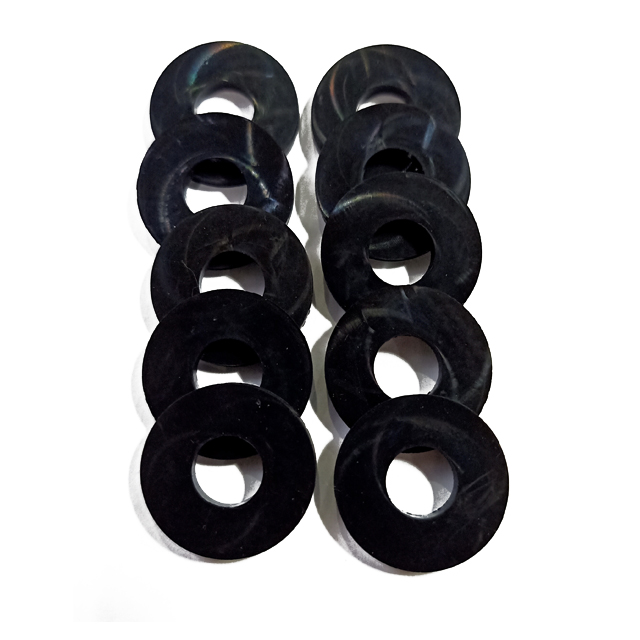
When reviewing industrial rubber flat gaskets and washers, provide the supplier with joint dimensions and damaged-part photographs.
For a confined seal, an engineered anti-extrusion feature or backup ring may be appropriate. Such components require suitable space and design review; they are not a general addition for every flat gasket.

Replace a damaged gasket with the approved part and test the corrected assembly under a defined procedure.
Where relevant, include pressure cycling, temperature exposure, fluid contact, and repeated opening. Define acceptable leakage and permitted dimensional changes before testing.
A successful initial test establishes performance under those conditions. It does not by itself prove long-term reliability.
Send the supplier:
Gasket and joint drawings.
Compound identification and specified hardness.
Free dimensions, assembled gap, and relevant tolerances.
Operating medium, temperature, and pressure history.
Fastener and assembly information.
Photographs showing orientation and damage.
Service duration and previous corrective actions.
Contact Lixu Rubber with this information to discuss replacement material and dimensional requirements. Providing the joint details helps evaluate the application more accurately than sending the damaged gasket alone.
No. Some bulging is expected as rubber changes shape under compression. Check whether it exceeds the approved allowance, damages the gasket, obstructs a passage, or reduces sealing contact.
It may help under suitable conditions, but clearance, pressure, temperature, support, and compound strength also matter. Confirm that the joint can apply the required closing load.
Yes. Excessive closure can displace rubber beyond its intended position, particularly where support or expansion space is inadequate. Tightening should follow the approved procedure.
Extrusion is material entering an unintended gap or moving beyond its intended location. Blowout generally describes a more substantial loss of the gasket’s sealing position. Extrusion can contribute to failure, but the terms are not interchangeable.
Trimming does not restore damaged material or correct the joint condition. Replace the damaged gasket and investigate the cause before reassembly.


