
Views: 0 Author: Site Editor Publish Time: 2026-10-09 Origin: Site


Precision sealing and mechanical assembly failures frequently originate from a fundamental engineering oversight: misclassifying and misapplying sealing components. The terms "washer" and "gasket" are often used interchangeably in procurement and maintenance, leading to improper load distribution, compromised pressure boundaries, accelerated component degradation, and costly system leaks. When field technicians grab whatever rubber ring fits the bolt, they risk immediate blowout or slow, undetectable fluid loss. Establishing a strict technical distinction between a rubber washer and a rubber gasket is critical for specifying the correct component. This guide breaks down their distinct mechanical functions, dimensional standards, and material selection criteria to ensure optimal performance in fluid, gas, and mechanical applications. We detail exact installation tolerances, material durometer requirements, and failure mitigation tactics to keep your fluid systems running without interruption.
Functional Distinction: Rubber washers primarily distribute mechanical loads, dampen vibration around fasteners, and prevent loosening, whereas rubber gaskets are designed to seal the junction between two stationary surfaces (like flanges) to prevent fluid or gas escape.
Dimensional Variability: Washers follow strict, uniform concentric dimensions (Inner Diameter, Outer Diameter, Thickness), while gaskets are often custom-cut to match complex mating surfaces and bolt-hole patterns.
Material Criticality: Both components rely heavily on elastomer selection (e.g., EPDM, Nitrile, Silicone, FKM) dictated by operating temperatures, chemical exposure, and environmental conditions.
Failure Mitigation: Selecting the wrong component—or over-torquing the right one—leads to extrusion, compression set failure, and loss of system integrity.
Table of Contents
A Rubber Washer primarily distributes the mechanical load of a threaded fastener. When you drive a bolt into a housing, the fastener head concentrates immense clamping force into a very small area. A washer spreads this force across a broader surface. This mechanical distribution prevents the bolt head from crushing softer substrate materials like plastics, fiberglass, or thin sheet metal. Beyond load distribution, these components provide reliable vibration isolation between rigid metal parts. The elastomer acts as a mechanical shock absorber. It dampens high-frequency vibrations generated by motors, pumps, or moving machinery.
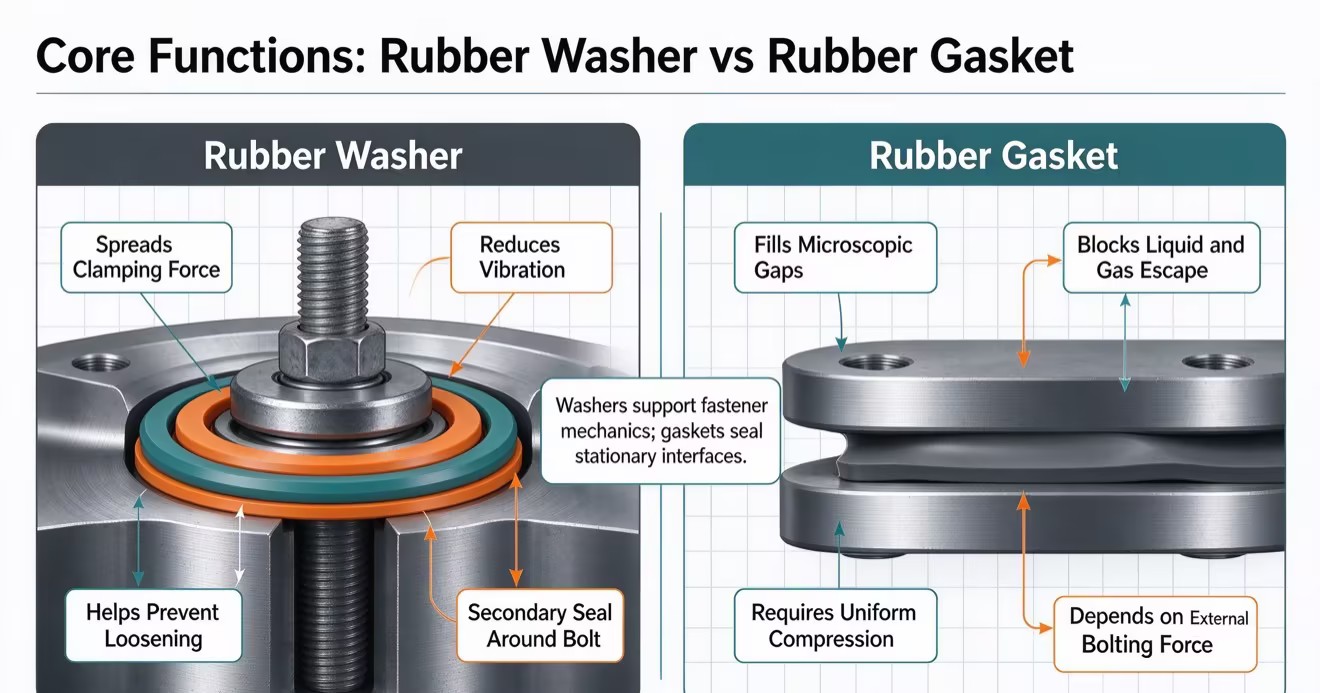
These components also act as a secondary seal around a bolt shaft. They maintain joint integrity by preventing fasteners from backing out. Continuous dynamic loads easily loosen rigid metal-to-metal connections. The elastic nature of the material absorbs kinetic energy effectively. This tensioning function keeps the assembly secure during heavy vibration. Rubber washers also prevent galvanic corrosion. They electrically isolate dissimilar metals, such as a stainless steel bolt driven into an aluminum housing. This stops the destructive electron transfer that causes rapid rusting.
However, they have strict limitations in high-pressure fluid containment. Their small surface area cannot withstand extreme hydraulic forces. High pressure will simply push the material out of the joint. They are not designed to bridge large gaps between equipment housings. You should only rely on them for low-pressure splash zones or localized fastener sealing.
A rubber gasket creates a reliable seal between two stationary mating surfaces by filling microscopic gaps under compression. Commonly used in pipe flanges, engine blocks, and industrial equipment, it prevents leakage of liquids and gases while blocking dust and moisture. Gaskets are typically die-cut or molded into various shapes and rely on external clamping forces to maintain sealing performance.
Rubber washers typically feature a simple ring shape, with specialized designs such as countersunk washers for flush fastener installation and shoulder washers for electrical isolation. Rubber gaskets offer more complex geometries, including full-face, ring-type, and custom die-cut profiles designed to match flange surfaces, bolt patterns, and equipment housings for effective sealing.
Analyzing the rubber washer vs gasket dynamic reveals distinct compression behaviors. A rubber washer reacts to localized torque from a single fastener. This concentrated force creates a high risk of localized extrusion. The pressure directly under the bolt head is immense. Precise torque control is mandatory during installation. Technicians must avoid crushing the material past its yield point. Once the rubber extrudes outward, it loses all tensioning and sealing properties.
Conversely, a rubber gasket requires uniform compression across a broad area. Achieving a proper seal demands strict adherence to flange bolt sequencing. Technicians must follow specific cross-pattern tightening procedures. You tighten opposite bolts in a star pattern, gradually increasing the torque in three distinct passes. This ensures even load distribution across the entire flange face. It prevents the gasket from pinching on one side. Uneven compression guarantees a blowout under pressure. The elastomer must compress evenly to fill all microscopic voids simultaneously.
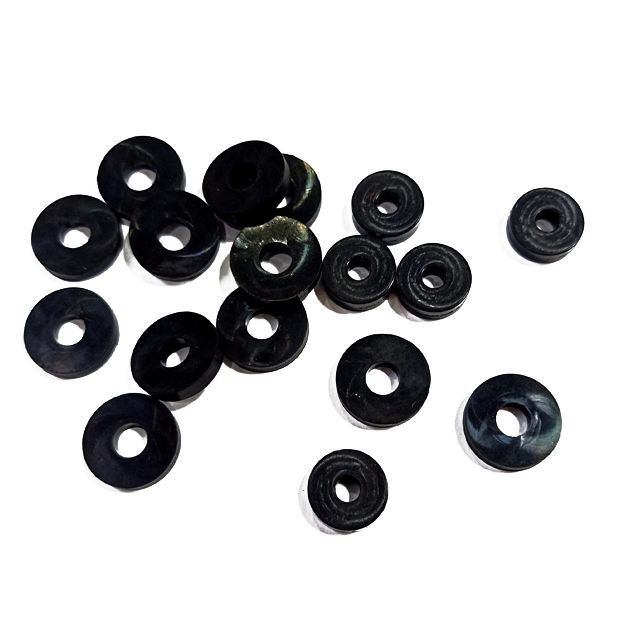
Measure a rubber washer using three key dimensions: Inner Diameter (ID), Outer Diameter (OD), and Thickness. Use digital calipers to measure each dimension gently without compressing or stretching the rubber. Check thickness at multiple points for consistency, and consider thermal expansion and fit tolerances to ensure proper sealing and fastener compatibility.
Rubber gasket sizing depends on Inner Diameter (ID), Outer Diameter (OD), Bolt Circle Diameter (BCD), and Thickness. For standard pipe flanges, refer to ASME B16.21 and applicable flange standards to ensure proper alignment. Thinner gaskets typically offer better resistance to blowout on smooth flange surfaces, while thicker gaskets can accommodate minor surface irregularities but may be more prone to extrusion under high pressure.
Flange Condition | Recommended Gasket Thickness | Blowout Resistance | Compressibility Requirement |
|---|---|---|---|
Perfectly flat, machined finish | 1/16 inch (1.5mm) | Excellent | Low |
Standard industrial finish | 1/8 inch (3.0mm) | Good | Moderate |
Pitted, warped, or uneven | 3/16 inch (4.5mm) or thicker | Poor (Requires careful torque) | High |
Selecting the correct elastomer is non-negotiable. The chemical makeup of the fluid and the operating temperature dictate the material choice. Using the wrong compound results in rapid swelling, embrittlement, or complete dissolution of the seal.
Nitrile (Buna-N): Nitrile offers excellent resistance to oil and fuel. It serves as the standard choice for automotive machinery, hydraulic systems, and fuel lines. It withstands petroleum-based fluids without swelling or degrading. However, it performs poorly when exposed to direct sunlight or ozone.
EPDM: EPDM provides optimal defense against outdoor UV rays. It resists ozone exposure and harsh weather conditions indefinitely. It performs exceptionally well in water, steam, and mild alkaline applications. Do not use EPDM with petroleum oils, as it will swell and fail immediately.
Silicone: Silicone handles extreme temperature fluctuations effortlessly. It remains flexible in freezing conditions down to -80°F and resists high heat up to 450°F. It is required for FDA-compliant sanitary environments, food processing, and medical devices. It has poor tear resistance, making it unsuitable for high-abrasion environments.
FKM (Viton): FKM represents a premium material for aggressive chemicals. It withstands high-heat industrial applications where standard rubbers fail. It resists aliphatic hydrocarbons, harsh acids, and synthetic lubricants. It is the go-to material for aerospace and chemical processing plants.
Shore A hardness directly impacts the component's compressibility. The material must seal without tearing under structural load. A lower durometer (e.g., 40A) indicates a softer, more pliable rubber that feels like a pencil eraser. A higher durometer (e.g., 80A) indicates a harder, more rigid compound that feels like a shoe heel. You must match the durometer to the available clamping force.
Use softer rubber for low-torque plastic assemblies or fragile glass housings. This prevents cracking the substrate while still achieving a seal. Specify harder rubber for high-torque metal flanges. Harder materials resist extrusion under heavy mechanical loads. They withstand the massive clamping forces generated by grade 8 steel bolts. Testing durometer requires a specialized Shore A gauge. You press the gauge needle into the rubber surface. The resistance provides a numerical hardness value. Selecting the wrong durometer guarantees a mechanical failure during assembly.
Selecting the right seal depends on system pressure, leak tolerance, media type, and operating temperature. High-pressure or airtight systems typically require specialized gaskets with reliable compression and material resistance, while low-pressure water applications may only need simple rubber washers. The seal must also maintain flexibility during thermal expansion and contraction to prevent leakage.
Rubber washers are ideal for vibration dampening, fastener support, and localized sealing, while rubber gaskets seal larger mating surfaces between equipment components. Maintenance should also be considered: washers are generally easier to replace, whereas gaskets often require more disassembly and downtime, making long-term durability essential.
Rubber washers are commonly used in HVAC systems, plumbing fixtures, automotive assemblies, and electronic enclosures for vibration isolation, cushioning, and localized sealing. Rubber gaskets are widely used in chemical pipelines, engines, hydraulic equipment, and industrial machinery to prevent fluid leakage and protect components from contamination.
Standard rubber washers are widely available, cost-effective, and easy to source in bulk. Custom rubber gaskets may require die-cutting, molding, or specialized tooling depending on their shape and application. For custom designs, manufacturers typically need accurate dimensions, CAD drawings, and material specifications to ensure proper fit and sealing performance.
Audit your current mechanical assemblies to verify if localized fastener loads require washers or if macro-interfaces demand full gaskets.
Cross-reference your system's maximum operating pressures and chemical exposure levels with specific elastomer material data sheets before installation.
Implement calibrated torque wrenches and strict star-pattern tightening sequences during assembly to prevent elastomer extrusion.
Consult with a specialized rubber manufacturer to design custom die-cut geometries when standard concentric dimensions fail to provide adequate surface coverage.
A: A rubber washer can act as a minor gasket in low-pressure, localized applications, such as sealing a single screw hole. However, it cannot replace a true gasket for sealing large mating surfaces or containing high-pressure fluids, as it lacks the surface area and structural design required for macro-interface sealing.
A: Use digital calipers to measure the exact distance across the center hole. Ensure the calipers lightly touch the inner walls without stretching or compressing the flexible rubber material. The ID must be slightly larger than the fastener thread to allow clearance without causing the washer to bulge upon installation.
A: Silicone and FKM (Viton) are the optimal choices for high-temperature environments. Silicone remains stable and flexible across extreme temperature fluctuations, while FKM offers superior heat resistance combined with excellent defense against aggressive industrial chemicals and petroleum-based fluids.
A: Standard rubber washers prevent minor fluid leaks in low-pressure applications, such as plumbing fixtures or splash zones. They seal the immediate area under the bolt head. They fail rapidly in high-pressure systems because hydraulic force easily pushes the small rubber profile out of the joint.
A: Gasket blowouts typically result from over-torquing, uneven flange compression, or selecting an elastomer with an incorrect durometer. Excessive clamping force crushes the material, causing it to extrude outward. Uneven bolt tightening creates weak points where high-pressure fluids can easily escape.
A: A standard rubber washer consists entirely of an elastomer, making it susceptible to outward extrusion under heavy torque. A bonded sealing washer fuses a rubber sealing ring to the inside edge of a rigid metal washer. The metal outer ring restricts the rubber from expanding outward, allowing it to withstand significantly higher pressures.


