
Views: 0 Author: Site Editor Publish Time: 2026-07-25 Origin: Site


Chemical incompatibility in sealing systems causes rapid degradation. It leads to catastrophic leaks and unplanned downtime. Engineers face a harsh reality when aggressive fluids attack elastomeric seals. Standard reference guides rarely tell the whole story. We must move beyond basic compatibility charts to finalize material selection. This article serves as a technical evaluation guide for your engineering teams.
Our objective is clear. We provide a transparent, evidence-based framework for specifying a reliable Chemical-resistant O-Ring. You will evaluate compounds based on operating environments and system risk tolerance. You will learn to evaluate materials systematically. We will explore how dynamic variables profoundly alter material performance. Furthermore, you will discover structured steps to validate your choices. Proper material specification ensures long-term operational integrity and environmental compliance before full-scale implementation begins.

Material Matching: No single elastomer resists all chemicals; FKM excels with hydrocarbons, while EPDM is required for polar solvents.
The Temperature Multiplier: Chemical compatibility is not static; elevated temperatures exponentially accelerate chemical attack and alter material resistance.
Failure Modes: Proper selection prevents volume swell, durometer shifts, and embrittlement, protecting system integrity.
Chemical attack fundamentally alters the cross-linked polymer structure of an elastomer. Elastomers rely on specific molecular bonds to maintain elasticity. Aggressive media can penetrate this matrix. They disrupt the molecular chains. This disruption prevents the seal from rebounding under compression. System integrity drops rapidly when these chemical bonds fail.
Engineers must evaluate several primary failure modes during material selection. Recognizing these mechanisms early prevents catastrophic system failure.
Volume Swell: The elastomer absorbs the chemical media. It acts like a sponge. This absorption causes massive expansion. The seal loses its dimensional tolerance. Extrusion out of the gland often follows.
Embrittlement and Durometer Shift: Certain chemicals extract plasticizers from the rubber. They leach out essential compounds. The seal hardens and cracks. It loses its compression set resistance entirely.
Chemical Cleavage: Highly aggressive fluids attack the polymer backbone directly. They break the main molecular chains. The material suffers a complete loss of physical properties. It turns into a gooey or powdery mess.
Material failure creates massive operational disruptions. A degraded seal causes compliance violations. Fluid leaks introduce severe environmental and safety hazards. Facility downtime halts production lines. You must tie every material choice directly to overall system reliability.
Standard A/B/C/D compatibility ratings are dangerously insufficient. They lack situational context. Most basic charts assume room-temperature exposure. They assume pure chemical states. Real-world applications rarely match these perfect laboratory conditions. You must evaluate the complete operating environment.
We utilize the STAMPED framework to guide sealing decisions. You must analyze these key decision variables thoroughly.
Media Composition: Pure chemicals behave predictably. Complex mixtures behave erratically. Trace additives act as catalysts. They accelerate chemical degradation unexpectedly. You must document every fluid component.
Chemical Concentration: Dilution levels drastically impact elastomeric resistance. A material might survive a 10% acid solution. It might disintegrate in a 90% concentration. Alternatively, water dilution can sometimes increase aggression.
Operating Temperature: Thermal load directly influences chemical reactivity. Heat accelerates chemical degradation exponentially. A fluid deemed compatible at 20°C often becomes highly destructive at 100°C. We call this the temperature multiplier effect.
Exposure Duration: Continuous immersion creates different stresses than intermittent exposure. Splash or vapor exposure introduces oxidation risks. Continuous immersion demands strict volume swell limits.
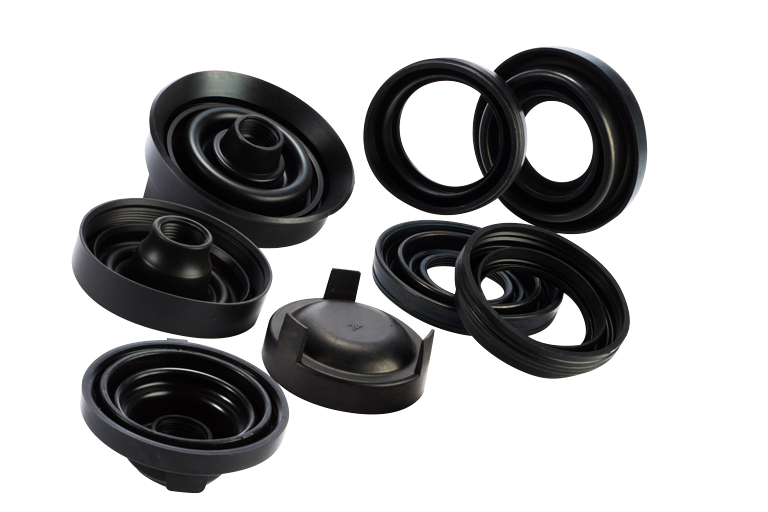
Engineers frequently evaluate two primary elastomers for industrial sealing. They offer complementary resistance profiles. Understanding their exact capabilities prevents misapplication.
Performance Attribute | FKM (Fluorocarbon) | EPDM |
|---|---|---|
Hydrocarbon Resistance | Excellent | Poor (Immediate Swell) |
Polar Solvent Resistance | Poor | Excellent |
Hot Water/Steam | Marginal to Poor | Excellent |
UV / Ozone Resistance | Outstanding | Outstanding |
Common Applications | Engine oils, fuels, aerospace | HVAC, automotive brakes, steam |
FKM dominates the petroleum and aerospace sectors. It boasts exceptional thermal stability. It handles continuous operating temperatures up to 200°C easily. FKM excels in applications involving aliphatic and aromatic hydrocarbons. It provides outstanding resistance to petroleum oils. It also resists UV and ozone exposure flawlessly.
However, FKM possesses distinct blind spots. It suffers rapid failure in polar solvents. You must never use it alongside ketones, acetone, or Skydrol. It also degrades quickly in low-molecular-weight organic acids. Standard FKM grades handle superheated steam poorly. The material will swell and blister under these specific conditions.
EPDM serves as the perfect counterpart. It fills the chemical gaps left behind. EPDM thrives in hot water and steam applications. It handles polar solvents masterfully. You can confidently deploy it against MEK and acetone. It works exceptionally well in automotive brake fluids. It also resists mild acids and alkalis effectively.
EPDM has one catastrophic limitation. It offers zero resistance to petroleum-based oils. It fails immediately in mineral oils and hydrocarbon solvents. Exposing EPDM to hydrocarbons causes immediate, severe swelling. The seal will extrude and rupture within hours.
Standard elastomers sometimes fall short. Extreme chemical mixtures demand higher-tier solutions. Aggressive amines easily destroy basic polymer structures. Semiconductor and pharmaceutical industries impose severe compliance needs. These scenarios trigger an escalation to perfluoroelastomers (FFKM).
Escalation introduces distinct engineering trade-offs. FFKM delivers nearly universal chemical resistance. It survives environments where everything else perishes. However, you face vastly longer procurement lead times. FFKM also requires careful installation handling. It lacks the elastic memory of standard rubber. PTFE-encapsulated options offer another route. They combine an elastomeric core surrounded by a chemical-resistant jacket. They provide chemical inertness but demand perfect hardware surface finishes.

Chemical compatibility tells only half the story. System mechanics heavily influence seal survival. You must evaluate how physical forces interact alongside chemical exposure. Mechanical stress accelerates polymer breakdown significantly.
Dynamic applications complicate material selection. Friction generates localized heat. This continuous movement exacerbates chemical wear. It strips away protective surface layers. The elastomer faces simultaneous abrasion and fluid attack. Dynamic systems require compounds featuring exceptionally high abrasion resistance. Static applications forgive minor swelling. Dynamic applications tolerate almost none.
Hardware clearances dictate acceptable volume swell limits. You must design glands to accommodate material expansion. If an elastomer swells 15%, the gland must offer adequate void volume. A fully confined seal will extrude through hardware gaps. It will shear under pressure. You must calculate thermal expansion alongside chemical swell.
Pressure decompression presents another severe risk. Volatile chemicals penetrate the elastomer matrix under high pressure. They dissolve into the rubber itself. A sudden pressure drop traps these gases inside. They expand rapidly trying to escape. This causes explosive decompression. The seal literally blows apart from the inside. You must specify rapid gas decompression (RGD) resistant compounds for volatile environments.
Selecting the correct material requires a methodical approach. Guesswork leads to inevitable system failures. Engineering teams must follow a rigorous shortlisting strategy. This structured process guarantees long-term reliability.
Step 1: Application Profiling
Start by documenting the exact operational parameters. Record the precise media composition. Identify all proprietary additives. Document maximum temperature spikes. Record the highest system pressure ranges. You cannot specify a material without this baseline profile.
Step 2: Cross-Referencing Data
Avoid generic polymer family charts. They mislead engineers constantly. Instead, utilize compound-specific compatibility data. Different curing methods alter chemical resistance. A peroxide-cured compound performs differently than a sulfur-cured compound. Request specific formulation data from your manufacturing partner.
Step 3: Balancing Performance vs. Risk Profile
You must balance material capabilities against system risk. Over-specifying a premium perfluoroelastomer creates complex procurement hurdles. Under-specifying a standard elastomer invites catastrophic leaks. Evaluate the consequences of a seal failure. A standard material suffices for low-risk systems. High-risk environments justify advanced engineered polymers. Choose the option aligned directly with system safety requirements.
Step 4: Prototyping and Immersion Testing
Never launch a full-scale rollout based purely on paper data. We strongly recommend real-world fluid immersion testing. Standardized procedures like ASTM D471 provide empirical validation. Submerge prototype samples in the actual system fluid. Apply the maximum operating temperature. Measure the subsequent volume swell. Verify the hardness changes. This physical validation confirms your theoretical selection.
Specifying a durable seal is a holistic engineering decision, not a simple chart lookup.
Aligning the exact chemical environment, temperature, and concentration with the proper polymer ensures reliability.
Mechanical variables like dynamic friction and hardware clearances heavily influence chemical performance.
Physical immersion testing validates theoretical data before full-scale implementation begins.
Do not leave your sealing systems to chance. Consult directly with a sealing specialist today. Request detailed material data sheets (MDS) for your specific media. Order sample compounds and initiate your internal immersion testing protocols immediately.
A: Absolutely not. They possess inherently opposite chemical resistance profiles. EPDM handles polar solvents flawlessly but fails immediately in petroleum oils. FKM handles oils and hydrocarbons excellently but disintegrates in polar solvents. Swapping them guarantees rapid seal failure.
A: Swelling occurs when the elastomer physically absorbs the chemical media. It acts like a sponge soaking up water. This absorption expands the polymer matrix. It decreases the seal's tensile strength and causes it to extrude out of the hardware gland.
A: No. Most generic charts assume room temperature testing utilizing pure chemicals. Real-world mixtures, elevated system temperatures, and dynamic pressures significantly alter material compatibility. You must validate choices through specific compound testing.


