
Views: 0 Author: Site Editor Publish Time: 2025-12-08 Origin: Site


Many people trust FKM O rings, but few know why they resist harsh chemicals so well. This gap matters because the science behind their strength affects real performance. In this post, you’ll learn the chemistry that makes FKM tough, how the material behaves under acids and heat, and why these properties matter in real-world sealing applications.
Understanding why an FKM O ring survives harsh chemicals starts at the molecular level. Its structure is unique, and it behaves differently from common elastomers. The material stays stable when acids or solvents attack, because the chemistry behind FKM is far stronger than most sealing materials.
FKM relies on the carbon–fluorine bond, the strongest single bond in organic chemistry. This bond holds a very high energy level, so it resists chain breaking caused by aggressive acids or industrial solvents. When harsh molecules attempt to penetrate the polymer chain, they meet a bond that rarely allows degradation. It gives the O ring a stable backbone, and it helps maintain its sealing shape even under stress.
Fluorine atoms sit densely around the carbon chain, and they act like a protective shield. They wrap the backbone, forming a barrier that repels polar, reactive molecules. Strong mineral acids struggle to reach the inner polymer network because fluorine blocks diffusion. This shielding effect limits chemical penetration into the elastomer matrix, so the ring stays intact longer.
Feature | Effect on Chemical Resistance |
High fluorine density | Blocks acid molecules from entering |
Strong electronegativity | Repels polar chemicals |
Tight molecular packing | Reduces diffusion pathways |
FKM contains no reactive double bonds, and that makes the material far less vulnerable to oxidation or ozone attack. Many elastomers, like natural rubber or NBR, degrade quickly because their double bonds react with air, heat, or ozone. FKM avoids this problem completely, and it keeps its surface smooth rather than cracking. This property matters in automotive or chemical systems where ozone levels rise.
FKM’s crosslinked network makes it difficult for chemicals to push molecules apart. Swelling often destroys seals in other elastomers, but FKM resists this because its structure stays tight. When an aggressive fluid enters a softer rubber, the polymer expands, loses strength, and fails. FKM differs because the strong links hold the geometry, preventing dimensional changes that would weaken the seal.
Different grades of FKM contain different fluorine levels. Higher-fluorine FKMs perform better in strong chemicals, especially fuels, oils, and corrosive mineral acids. Fillers and compounding also affect how well the O ring survives contact with acids. Some grades fail in oxidizing acids, such as nitric acid, because the acid attacks the structure faster than the polymer can resist. More fluorine improves durability, while lower levels reduce resistance.
Common FKM Grades and Behavior
Grade | Fluorine Level | Chemical Resistance | Notes |
A type | Lower | Good for fuels | Limited acid resistance |
B type | Medium | Better acid resistance | Used in automotive |
F type | High | Strong solvent and acid resistance | Performs in harsh media |
Specialty FKM | Very high | Aggressive chemical resistance | Still fails in strong oxidizers |
Heat increases molecular mobility, and it speeds up chemical reactions. An FKM O ring that performs well at room temperature may degrade when exposed to hot, concentrated acids. Higher temperatures let acid molecules penetrate faster, and they cause the polymer chain to move more freely. This combination weakens the surface, and the seal loses elasticity. It explains why sulfuric acid becomes more damaging as heat rises.
Different acids attack in different ways. Hydrochloric acid, even at high concentration, rarely breaks FKM’s bonds because it is not a strong oxidizer. Sulfuric acid becomes more aggressive at high concentrations, especially when hot. Nitric acid is strongly oxidizing, and it attacks the polymer rapidly even at low concentration. Organic acids, such as acetic or formic acid, behave more mildly, though high temperatures still increase swelling.
Acid | Behavior Against FKM | Reason |
HCl | Strong resistance | Not highly oxidizing |
H₂SO₄ | Good at low concentration, poor when hot | Oxidation increases with heat |
HNO₃ | Very poor | Strong oxidizer breaks polymer |
Acetic/Formic | Moderate to good | Weaker acids, slower attack |
FKM O rings show their true value when they face real chemicals. Their stability depends on how different fluids interact with the fluorinated polymer. Some acids barely affect the material, while others attack quickly. The behavior varies, and it is closely tied to oxidation strength, temperature, and concentration.
FKM performs very well in many mineral acids. Hydrochloric acid rarely damages the polymer, even when the acid reaches typical high concentrations. The ring keeps its shape, and it avoids softening or swelling because HCl does not strongly oxidize the chain. Sulfuric acid behaves differently. It stays manageable at low concentration, but strong, hot sulfuric acid becomes highly oxidizing. It makes the polymer soften or crack because the acid reacts faster as heat increases.
Acid | FKM Resistance | Notes |
HCl | Excellent | Non-oxidizing, limited attack |
Low-strength H₂SO₄ | Good | Acceptable at low heat |
Concentrated H₂SO₄ | Poor | Oxidizing when hot |
Nitric acid is one of the most damaging fluids for FKM. It attacks even at low concentration, and the reaction happens fast. The acid oxidizes the polymer surface, breaks the chains, and reduces elasticity. The ring may turn brittle, swell, or lose strength within a short time. It struggles in environments where strong oxidizers remain present, and it cannot maintain sealing performance in these systems.
FKM behaves differently in organic acids because these acids show weaker oxidation. Acetic acid, even when strong, interacts slowly, and the ring stays stable in most temperatures. Formic acid becomes more aggressive when heat or concentration increases. The polymer begins to swell, and it may lose hardness because formic acid penetrates the matrix faster. Both acids remain manageable in mild conditions, and they are common in food and chemical equipment.
Organic Acid | FKM Response | Reason |
Acetic acid | Good | Mild acid, slower reaction |
Formic acid | Moderate | Swelling at high strength or heat |
FKM resists a wide range of solvents, oils, and fuel blends. It keeps its sealing force in aromatic hydrocarbons, bio-fuel mixtures, and aggressive petroleum products. Many fuel systems generate acidic by-products, and FKM handles them well. It stays stable in engine oils, hydraulic fluids, and aviation fuels, which makes it common in automotive and aerospace sealing. These industries depend on materials that survive chemical exposure, and FKM fits these environments because it resists swelling, vapor attack, and breakdown during long operation.
Chemical resistance in FKM O rings does not depend on chemistry alone. Their environment changes how they react, and it affects performance in real applications. Temperature, pressure, motion, and ozone levels all shape how long the seal survives harsh media. Each factor influences polymer mobility or chemical access, and it can either protect the ring or speed up damage.
Heat increases molecular motion inside the elastomer, and it allows chemicals to enter the polymer matrix faster. An FKM O ring may stay stable at room temperature, but it fails quickly in hot, concentrated sulfuric acid. At 90°C, sulfuric acid becomes more oxidizing, so the acid attacks and softens the material in a shorter time. The ring loses elasticity because heat accelerates reactions on the surface. It becomes more vulnerable in systems where temperature rises during operation, such as pumps, engines, or chemical reactors.
Temperature | Effect on FKM | Chemical Behavior |
Room temperature | Stable | Slow reaction rate |
Moderate heat | Increased mobility | Faster chemical penetration |
High heat (90°C+) | Degradation risk | Strong oxidizers become aggressive |
Chemical concentration matters because stronger fluids react faster. A short chemical splash may not harm the O ring, since the exposure time is too brief for significant penetration. Continuous immersion changes the situation. The chemical stays in contact for hours or days, and it diffuses deeper into the polymer. As time increases, the ring absorbs more fluid, and it may swell or harden depending on the media. Concentrated acids, especially in industrial tanks or piping systems, cause faster degradation because the acid molecules reach the surface more densely.
Pressure forces chemicals into the elastomer, and dynamic motion adds mechanical stress that speeds up chemical entry. When a seal moves repeatedly, the polymer expands and contracts. This motion opens micro-channels that allow fluid to enter more easily. High-pressure hydraulic systems increase this effect. The chemical pushes deeper into the seal, and it weakens the network. It becomes especially noticeable in pumps, valves, and rotating shafts because the seal experiences both force and repeated movement.
Factor | Influence on Chemical Resistance |
High pressure | Drives chemicals into polymer |
Repeated motion | Opens pathways for diffusion |
Combined stress | Accelerates wear and swelling |
Ozone attacks many elastomers, but FKM holds up extremely well. Its fluorinated backbone resists oxidation because it contains no reactive double bonds. NBR, by contrast, cracks quickly in ozone-rich areas, such as near electrical equipment or outdoor systems. FKM avoids surface cracks, and it keeps its elasticity even in environments where ozone levels rise due to machines or chemical processes. This resistance helps in aerospace, automotive under-hood areas, and plants that generate ozone during reactions.
Material | Behavior in Ozone | Typical Result |
FKM | Strong resistance | No cracking |
NBR | Weak resistance | Surface cracks, failure |
FKM O rings prove their value once they enter real operating environments. Their chemistry lets them survive acids, fuels, heat, ozone, and organic fluids that easily damage other elastomers. These case studies show how the material performs when the demands become extreme, and why industries rely on fluorinated seals for long-term stability.
Chemical plants expose seals to strong acids, solvents, and reactive fluids every day. Pumps and valves often run continuously, and the O rings sit in constant contact with corrosive media. FKM performs well because its carbon–fluorine bonds resist chemical attack, and they stay stable under long immersion. The structure prevents swelling, so the ring keeps its geometry and avoids leakage failures. It works in sulfuric acid lines, hydrochloric acid pumps, and solvent transfer systems where many elastomers fail quickly.
Requirement | FKM Behavior |
Acid exposure | High stability, no cracking |
Continuous contact | Minimal swelling |
Solvent handling | Strong chemical resistance |
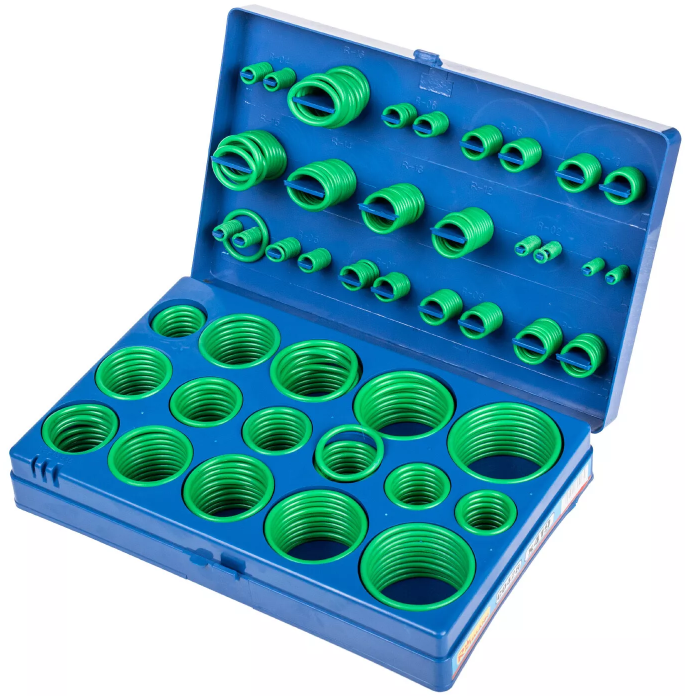
Modern engines generate acidic fuel by-products, and they use fuel blends that challenge traditional rubbers. FKM O rings hold their shape in gasoline, ethanol mixtures, and diesel fuel. They also resist coolant additives that slowly become acidic during long use. Many manufacturers use Green Viton O rings in injectors, fuel pumps, and emission systems because these seals stay flexible under heat and chemical stress. The ring maintains sealing force even when engine temperatures rise sharply.
Food processing equipment frequently contains organic acids, such as vinegar or acetic acid, which require a stable sealing material. FKM handles these acids because the polymer repels polar molecules and slows diffusion. It works in fermentation tanks, bottling equipment, and mixing lines where corrosion and hygiene matter. The ring stays smooth and avoids cracks, so it keeps liquid from leaking into or out of the system.
Aerospace environments expose seals to ozone, low pressure, and electrical discharge. FKM remains stable at altitude because it avoids ozone cracking, unlike materials such as NBR. It also withstands rapid temperature changes around aircraft engines and electrical systems. Ozone generated near high-voltage components usually damages most elastomers, but FKM’s fluorinated backbone prevents surface deterioration. Aerospace teams select it when the equipment must operate safely under harsh atmospheric and electrical conditions.
FKM O rings resist chemicals because fluorinated polymers stay strong under harsh fluids. This insight helps engineers choose better sealing materials for complex environments. The right FKM grade must match the chemical type, temperature, and exposure time. LIXU offers high-quality FKM solutions that provide long service life and reliable performance across demanding applications.
A: An FKM O ring resists chemicals because its fluorinated polymer bonds stay stable under acids, fuels, and solvents.
A: An FKM O ring has strong carbon–fluorine bonds, while NBR reacts faster to ozone and oxidizing acids.
A: Yes, strong oxidizers like nitric acid can break polymer chains even in high-grade FKM O rings.
A: Higher heat and stronger acids increase reaction speed, reducing FKM O ring durability.


