
Views: 0 Author: Site Editor Publish Time: 2026-03-26 Origin: Site


You need to choose the right NBR gasket by matching its features to your specific working conditions. NBR gaskets are made from nitrile butadiene rubber, a material that resists damage from oil and fuel. These gaskets are commonly used in various applications, including:
Car engines and fuel systems
Oil and gas pipes and valves
Factory machinery
Chemical plants
When you choose the right NBR gasket, consider factors such as the type of fluid, heat, pressure, sealing surface, and the surrounding environment. This guide will help you take easy steps to choose the right NBR gasket for your job.
Pick NBR gaskets for jobs with oil, fuel, and chemicals. They stop damage and make strong seals.
Always check if the gasket works with your fluids. Using the wrong gasket can cause leaks and failures.
Think about temperature and pressure limits when you pick a gasket. NBR gaskets work best in certain ranges to stay effective.
Make sure the gasket fits by measuring the flange and gasket size. If it does not fit well, leaks and failures can happen.
Use a checklist to help you choose the right gasket. This helps you avoid mistakes and meet all needs.
You might wonder why people use NBR for gaskets. NBR means nitrile butadiene rubber. This rubber is made in a lab. It does not get damaged by oil, fuel, or many chemicals. To make NBR gaskets, workers mix raw rubber with other things. These things are fillers, additives, and curing agents. Next, they pour the mix into molds to shape it. After shaping, they heat the rubber. This step is called vulcanization. Vulcanization makes the gasket stronger and more bendy. When the rubber cools, workers cut the gaskets and check them. They make sure each gasket is good and safe to use. These steps help the gasket work well in hard places.
Tip: NBR gasket material is a top choice when you need a seal that can handle oil, grease, or fuel.
NBR gaskets are used in many jobs because they have special features. This gasket material works best where oil resistance and strong seals are needed. Here are some ways people use them:
Automotive: NBR gaskets are found in engines, fuel systems, and hydraulic parts. They do not break down from oil or fuel. This makes them good for cars and trucks.
Oil & Gas: NBR gasket material works in pipelines and valves. It is strong and keeps fluids inside.
Food Processing: FDA-approved NBR gasket material seals machines and hoses for fatty or greasy foods. These gaskets are simple to clean and help keep things clean.
NBR gaskets also do not let much gas pass through. They do not wear out fast. You can count on this gasket material to stop leaks, even when there is pressure. When you pick NBR, you get a gasket that can handle hard work and keeps your machines working well.
Image Source: pexels
You need to think about a few important things when picking the right NBR gasket. Each thing can change how well the gasket works for you. You must match what the gasket can do with what you need. Here are the main things to look at before you pick your gasket:
Temperature range during operation
Type of fluid or chemical in contact with the gasket
Flange type and surface finish
Gasket size and geometry
Always check if the gasket material can handle the fluids or chemicals in your system. NBR gaskets work well with oils, fuels, and many chemicals. But some chemicals can hurt NBR. Using the wrong gasket can cause leaks or make the gasket fail.
The table below shows how NBR compares to other gasket materials with different fluids and chemicals:
Fluid/Chemical | NBR (Buna-N/Nitrile) | Neoprene | EPDM | Silicone | Viton |
|---|---|---|---|---|---|
Black Liquor | Good (B) | Good (B) | Good (B) | Good (B) | Excellent (A) |
Bleach Solutions | Poor (D) | Poor (D) | Excellent (A) | Good (B) | Excellent (A) |
Boiled Linseed Oil | Good (B) | Excellent (A) | Good (B) | Poor (D) | Excellent (A) |
Boracic Acid | Excellent (A) | Excellent (A) | Excellent (A) | Excellent (A) | Excellent (A) |
Brake Fluid - Automotive | Good (B) | Fair (C) | Excellent (A) | Fair (C) | Poor (D) |
Legend: A = Excellent, B = Good, C = Fair, D = Poor
NBR gaskets give good protection against oils and hydrocarbons. They do not work well with strong oxidizers or some harsh chemicals. If your job uses tough chemicals, you may need to use Viton or EPDM instead. Always check a chemical compatibility chart before you pick the right NBR gasket.
Tip: If you use a fluid that is not oil or fuel, check if it works with NBR. This step helps you stop gasket problems early.
You should know the temperature and pressure in your system. NBR gaskets have limits. If you go past these, the gasket might not work. The table below shows the normal temperature range for NBR gaskets:
Property | Value |
|---|---|
Minimum Service Temperature | -35°C (-31°F) |
Maximum Continuous Temperature | +120°C (248°F) |
Maximum Intermittent Spike | +135°C (275°F) |
NBR gaskets can handle most low and medium temperatures. They work well in engines, pumps, and pipes. If your system gets hotter than 120°C (248°F), you should use a different gasket material. Pressure matters too. High pressure can squeeze the gasket too much or make it leak. Always check the pressure rating before you pick your gasket.
Note: Most NBR gaskets work best with medium pressure. If you need a gasket for high pressure or heat, look at other choices.
The place where you put the gasket is very important. If the surface is rough or damaged, the gasket may not seal well. Always clean and check the flange before you put in the gasket. NBR gaskets can fill small gaps, but not big ones.
Clean and smooth surfaces help the gasket seal better.
If the surface is too rough, leaks can happen.
Always check for scratches or dents on the flange.
You also need to make sure the gasket size and shape fit the flange. If the gasket does not fit, it will not seal. Use the right tools to measure the flange and bolt holes. The table below shows the best ways to measure for a good fit:
Measurement Aspect | Recommended Method |
|---|---|
Outer Diameter (OD) | Use a digital caliper at the widest point. |
Inner Diameter (ID) | Measure at the bore edge, avoid threads. |
Flange Thickness | Use a thickness gauge at several points. |
Bolt Circle Diameter (BCD) | Measure center-to-center of opposite bolt holes. |
Bolt Hole Diameter | Measure at the narrowest part. |
Flange Face Types | Know if it is RF, FF, or RTJ to guide your gasket choice. |
Recommended Tools | Use digital calipers, rulers, and gauges for best results. |
Alert: Most gasket failures happen because of poor fit or bad surface conditions. Over-compression and wrong gasket choice cause about 60% of failures. Always measure carefully and check the flange before you choose the right NBR gasket.
When you pick the right NBR gasket, you keep your system safe from leaks and damage. You also help the gasket last longer and work better for your job.

Image Source: pexels
When you pick a gasket, make sure its features fit your needs. Each feature changes how well the gasket works and how long it lasts. Check for oil and fuel resistance, flexibility, compression, and how it handles sunlight and ozone. Doing this helps you get the best results and avoid trouble.
If you use a gasket in engines, pumps, or fuel systems, oil and fuel resistance is very important. NBR gaskets are great because they do not get damaged by oil and fuel like many other materials. You can see how NBR compares to EPDM and FKM in the table below:
Material | Oil and Fuel Resistance | Typical Temperature Range | Weather and Ozone Resistance | Relative Cost |
|---|---|---|---|---|
NBR (Buna-N) | Very good | -30 to +120 °C | Fair to poor | Medium to low |
EPDM | Poor to fair | -50 to +150 °C | Excellent | Medium |
FKM (Viton®) | Excellent | -20 to +200/250 °C | Very good | Very high |
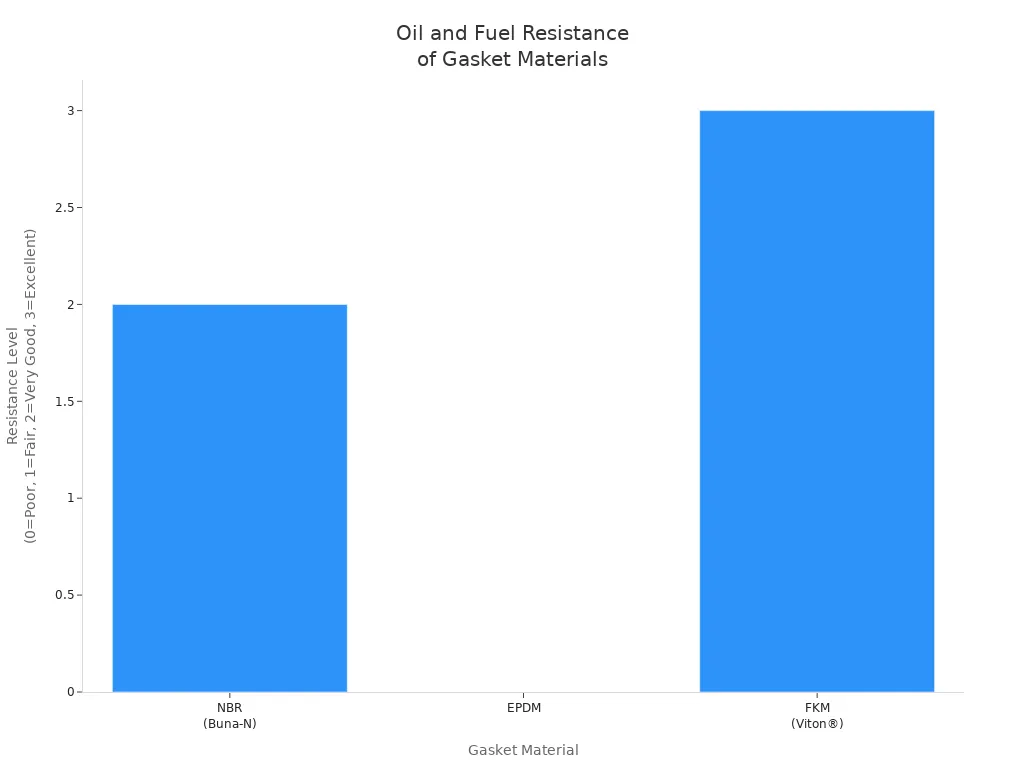
NBR is a smart pick for jobs with oil and fuel. EPDM gets bigger and breaks in oil, so do not use it for these jobs. FKM works even better than NBR, but it costs a lot more. The chart below shows how well these materials resist oil and fuel:
Tip: Always check what fluid is in your system before you pick a gasket.
You want your gasket to stay bendy and seal tight, even after many uses. NBR gaskets keep their shape and bounce back after being pressed. This helps them seal well and work for a long time. The table below shows how NBR gaskets handle being used again and again at different temperatures:
Aging Condition | Temperature (°C) | Deformation Rate (%) after 7 days |
|---|---|---|
Thermal–Oxygen | 125 | 83.23 |
Thermal–Oxygen | 85 | 49.88 |
Thermal–Oil | 125 | 66.89 |
Thermal–Oil | 85 | 44.12 |
You can see that higher heat makes the gasket change shape more. If your job gets hot, check the gasket often to make sure it still seals.
Note: If the gasket stays squished or cracks, it can leak. Change the gasket if you see these problems.
NBR gaskets do not do well in sunlight or ozone. If you use them outside, they might crack and get weak. This can make them leak. The table below shows how NBR does compared to other materials:
Material | UV/Ozone Resistance |
|---|---|
NBR | Poor |
EPDM | Excellent |
Silicone | Excellent |
NBR gaskets have poor resistance to UV and ozone.
Sunlight and ozone can make cracks and weaken the gasket.
Do not use NBR outside for a long time.
Alert: Keep NBR gaskets in a cool, dark place. Keep them away from sunlight and ozone until you use them.
When you pick the right gasket for your job, you get better results and longer life. Always match what you need with what the gasket can do before you choose.
Sometimes, your equipment needs a special gasket. Custom gaskets help you get a perfect fit. They work better in hard jobs. You can pick from many shapes and sizes. Some gaskets are made for high pressure or strange angles. The table below lists custom options and where you use them:
Type | Key Applications | Customization Level |
|---|---|---|
NBR O-Rings | Hydraulic systems, fuel lines, pumps | High (ID, OD, hardness) |
NBR Ferrule Gaskets | High-pressure piping, industrial joints | Very High (with metal specs) |
NBR Oval Gaskets | Custom machinery, enclosures | Extreme (shape-specific) |
NBR Internal Skew | Gearboxes, rotating shafts | Very High (angle-specific) |
NBR Double Skew | Heavy machinery, aerospace | Maximum (multi-parameter) |
Custom gaskets cost more than regular ones. If you want special shapes or materials, the price goes up. Small orders also cost more for each piece. You pay extra for better quality and trust.
You need to check if your gasket follows the rules for your job. Some jobs need special certificates to keep people safe. Here are some important rules:
NSF/ANSI 61 for safe drinking water
FDA rules for food contact
USP Class VI for medicine use
These rules make sure your gasket is safe for people and products. Always ask your seller for proof before you buy.
Sometimes, you need a different gasket for better safety or trust. The table below shows other common choices:
Gasket Material | Temperature Range (°C) | Key Applications | Advantages | Disadvantages |
|---|---|---|---|---|
Silicone | -60 to 230 | High-temperature, food-grade | Great heat resistance, food safe | Not good with oils |
FKM | -26 to 204 | Automotive, chemical processing | Strong chemical resistance | High cost, less stretchy |
EPDM | -40 to 120 | Outdoor, steam valves | Good UV and weather resistance | Not for oils or fuels |
PTFE | -200 to 260 | Food, sanitary, corrosive fluids | Top chemical resistance, low friction | Weak strength, can deform |
Pick the right gasket material for your job. This helps your system stay safe and work well.
You can use a checklist to help you pick the right gasket for your job. This list helps you avoid common mistakes and makes sure you do not miss any important steps.
Check the temperature range your gasket must handle. Write down the lowest and highest temperatures.
Find out the pressure in your system. Make sure your gasket can handle it.
Identify the fluids or chemicals that will touch the gasket. Look for any harsh or abrasive substances.
Think about sunlight and ozone. If your gasket will be outside, you need to check for UV and ozone resistance.
Review any special product needs, like EMI shielding or food safety.
Make sure your gasket meets industry standards, such as ASTM or FDA rules.
Do not mix different gasket materials in the same system.
Never reuse old gaskets. Always use a new one for each job.
Tighten the gasket just enough. Do not over-tighten, or you could damage your equipment.
Choose quality over price. Cheap gaskets can cost more in the long run.
Tip: A checklist helps you catch problems early and keeps your system safe.
Sometimes, you need help from a gasket expert. You should ask for advice in these situations:
You have a complex system with high pressure, heat, or strong chemicals.
Your job needs special rules, like FDA or REACH approval.
You want to make sure your gasket can handle vibration or temperature changes.
You need help with proper installation or maintenance.
You are not sure if lab ratings match your real working conditions.
Experts can help you avoid leaks, downtime, and costly mistakes.
You should pick an NBR gasket that fits your job. This helps your machines work better and last longer. If you use the right gasket, you can save money and time. The table below shows what happens if you pick the right or wrong gasket:
Aspect | Correct NBR Gasket | Incorrect NBR Gasket |
|---|---|---|
Durability | Good NBR gaskets last longer and need fewer changes. | Bad gaskets break often and cost more to replace. |
Compatibility | The right gasket works well with fluids and stops damage. | The wrong gasket can leak and hurt your system. Repairs can be expensive. |
Maintenance | You do not need to fix things as much with the right gasket. | You will fix things more if the gasket fails a lot. |
Use the checklist to help you pick fast.
Talk to an expert if your job is hard or very important.
Ask for help if you have questions or need more info.
NBR gaskets resist oil and fuel very well. You can use them in engines, pumps, and machines that handle these fluids. They last longer than many other gasket types in these jobs.
You should avoid using NBR gaskets outside for long periods. Sunlight and ozone can damage them. If you need a gasket for outdoor use, pick EPDM or silicone instead.
Measure the inside and outside diameters. Check the bolt hole size and spacing. Use a ruler or caliper for accuracy. Always compare your measurements to the flange drawing.
Some NBR gaskets meet FDA or NSF standards. You must check for these certifications before using them with food or water. Ask your supplier for proof.


