
Views: 0 Author: Site Editor Publish Time: 2026-07-23 Origin: Site


Premature seal failure is rarely a manufacturing defect. It usually comes down to a miscalculation in specification. Engineers often trace the root cause back to improper durometer selection. You face a constant engineering tension in fluid power and sealing applications. You need a material soft enough to fill microscopic hardware imperfections. Yet, it must remain hard enough to bridge extrusion gaps under high systemic pressure. Relying on standard assumptions often leads to catastrophic leaks or accelerated wear.
We need a systematic framework for evaluating O-Ring hardness,material selection. This means moving beyond the default 70-durometer mindset. You must align your material choices with specific pressure ratings, temperature extremes, dynamic operational requirements, and long-term reliability metrics. Proper specification prevents unplanned downtime and extends the operational life of the entire mechanical assembly.
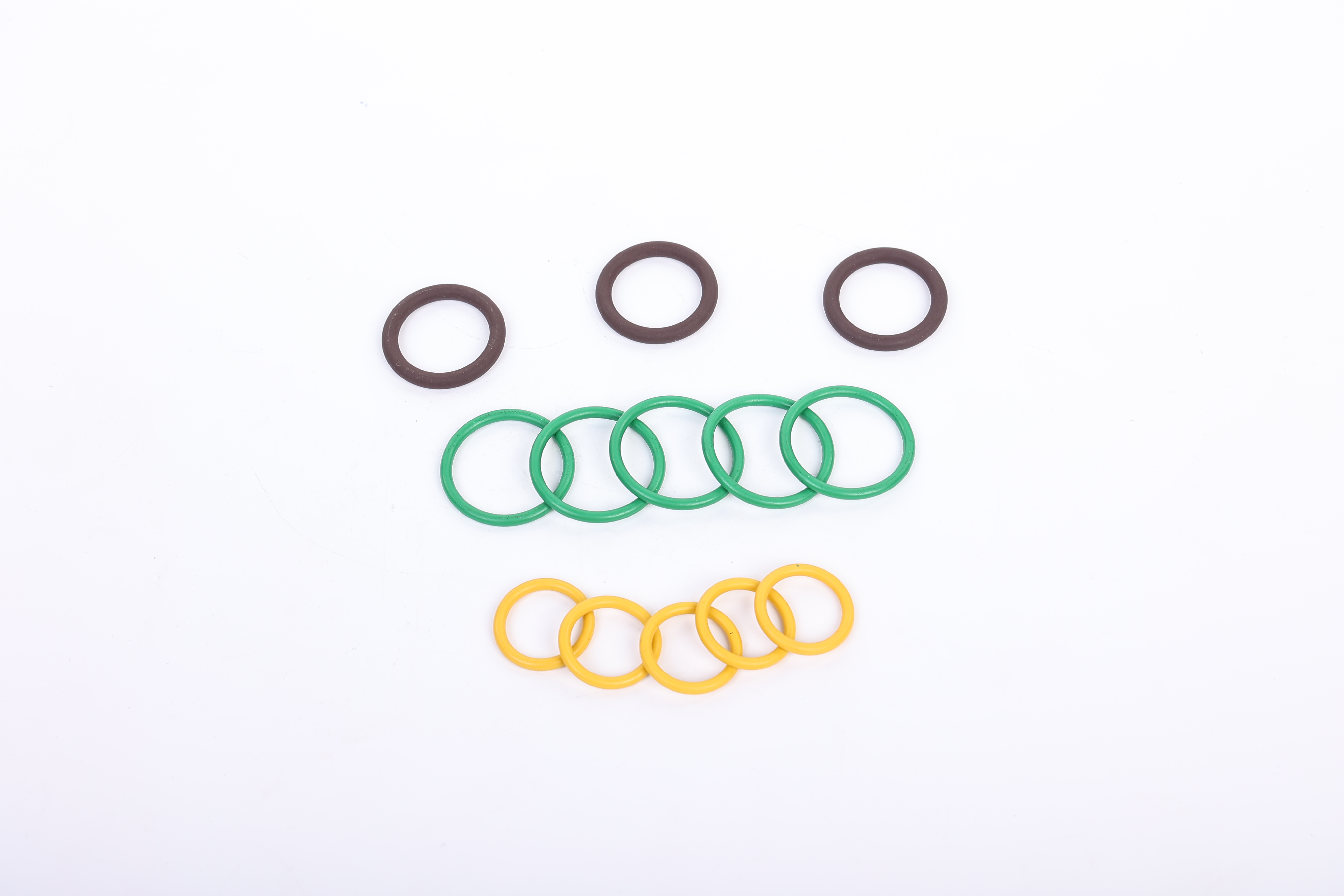
The Extrusion Threshold: O-ring hardness directly dictates pressure capacity; harder compounds (e.g., 90 Shore A) are mandatory for high-pressure systems to prevent gap extrusion.
The Sealing Compromise: Softer materials provide superior conformity to irregular surfaces and require less compressive force, reducing the risk of micro-leakage in low-pressure or vacuum environments.
Dynamic vs. Static Variables: Material hardness impacts friction and wear rates in dynamic applications, requiring a precise balance to avoid excessive heat generation or rapid abrasion.
Environmental Hardness Shift: Operating temperatures, radiation, and chemical exposures dynamically alter the effective hardness of an elastomer in the field, necessitating safety margins during material selection.
The Danger of the Default: Standard 70 Shore A O-rings are highly versatile but prone to premature failure in specialized, high-stress, or extreme-reliability industrial environments.
Table of Contents
The industry standard for measuring the indentation resistance of elastomeric materials is the Shore A hardness scale. Defined by ASTM D2240, this scale quantifies how well a specific rubber compound resists physical deformation under a concentrated load. Hardness is not a measure of material strength or tear resistance. It strictly evaluates how much the elastomer yields when subjected to localized pressure. This metric serves as the foundational data point when we specify seals for fluid and gas containment systems. You cannot design a reliable hydraulic cylinder without first understanding exactly how the elastomer will behave under mechanical stress.
Technicians measure durometer physically using a calibrated indenter foot. The device presses a hardened steel pin into the surface of the rubber sample. The depth of penetration correlates directly to the hardness value on a dial or digital readout. It is important to note that nominal hardness specifications typically carry a manufacturing tolerance of ±5 points. A batch specified at 70 Shore A might legally measure anywhere from 65 to 75 Shore A. You must account for this tolerance stack-up when designing critical sealing glands.
Place the elastomer specimen on a hard, flat surface to prevent false readings from background yielding.
Apply the durometer gauge vertically with a firm, consistent motion to ensure the indenter penetrates accurately.
Read the value within one second of firm contact, as elastomers exhibit creep and the reading will drop over time.
Take multiple readings across different areas of the sample and average the results to account for localized material variations.
The Shore A scale runs from 0 to 100, but the practical range for elastomeric seals is much narrower. Most industrial applications utilize materials falling between 50 and 90 Shore A. The 70 Shore A rating serves as the baseline standard for general applications. It offers a reliable balance of flexibility, compression set resistance, and extrusion resistance. Materials below 60 Shore A feel noticeably soft and spongy. Compounds measuring 90 Shore A feel dense and rigid, similar to a hard plastic wheel. We rarely use anything below 50 Shore A for standard fluid sealing because the material lacks the structural integrity to maintain radial squeeze.
Engineers must sometimes transition from the Shore A scale to the Shore D scale. Shore D measures harder plastics, rigid polymers, and materials like PTFE. You make this transition when designing extreme high-pressure backup rings or specialized structural seals. While Shore A handles softer rubbers that deform easily, Shore D evaluates materials that resist significant mechanical yielding. Using a Shore D backup ring alongside a Shore A elastomer seal provides the necessary structural support to prevent catastrophic extrusion in high-pressure hydraulic cylinders.
Comparison of Shore A and Shore D Scales for Sealing Applications | |||
Scale | Typical Materials | Primary Sealing Function | Indenter Shape |
|---|---|---|---|
Shore A | Nitrile, Fluorocarbon, Silicone, EPDM | Primary fluid and gas containment, dynamic wiping | Flat cone (35-degree angle) |
Shore D | PTFE, PEEK, Hard Polyurethane, Nylon | Anti-extrusion backup rings, high-pressure structural support | Sharp cone (30-degree angle) |
Systemic pressure forces the elastomer into the clearance gap between mating hardware components. This physical displacement is the mechanics of extrusion. When fluid or gas pressure builds behind the seal, it pushes the rubber toward the low-pressure side of the gland. If the pressure exceeds the material's structural capacity, the rubber flows into the microscopic gap between the metal or plastic parts. This causes the seal to shear, nibble, and eventually fail entirely. We see this constantly in heavy equipment hydraulics where pressure spikes exceed the design limits of standard seals.
Hardness acts as a physical barrier against this deformation. Higher durometer materials resist yielding under pressure. This direct correlation allows engineers to design systems with larger clearance gaps or operate at higher systemic pressures without risking seal failure. A 90-durometer compound will maintain its structural integrity across a gap that would instantly destroy a 70-durometer compound under the same pressure. You must match the hardness to the maximum anticipated pressure spike, not just the nominal operating pressure.
Low-durometer seals face the risk of sudden structural collapse. When subjected to rapid pressure spikes, soft materials can flatten completely against the gland wall. This flattening compromises the radial squeeze necessary to maintain the seal, leading to immediate blow-by. You must evaluate the pressure-to-clearance ratio carefully. If you have a large diametrical clearance, you cannot use a 70 Shore A seal, regardless of how low the system pressure is.
Standard Pressure vs. Clearance Gap Reference for Hardness Selection | ||
System Pressure (PSI) | Max Clearance Gap (Inches) | Recommended Minimum Hardness (Shore A) |
|---|---|---|
Up to 1,000 | 0.004 - 0.006 | 70 |
1,000 to 2,000 | 0.003 - 0.005 | 80 |
2,000 to 3,000 | 0.002 - 0.004 | 90 |
Above 3,000 | < 0.002 | 90 + Backup Ring |
Softer materials, typically in the 50-60 Shore A range, easily deform to seal scratched, pitted, or non-concentric hardware surfaces. This conformity makes them ideal for sealing rough cast housings or applications where machining perfect surface finishes is impossible. The soft rubber flows into the microscopic valleys of the metal, blocking leak paths effectively under low compressive loads. We often use 60 Shore A seals on cast aluminum pump housings where the surface finish is less than ideal.
However, you must evaluate the mating hardware stress. Harder seals require significantly higher compressive loads to achieve a positive seal. If you install a 90-durometer seal into a plastic housing or a thin-walled aluminum tube, the force required to compress the rubber might crack or warp the hardware. You must balance the need for extrusion resistance against the structural limits of your mating components. A seal that breaks the housing is worse than a seal that leaks.
Initial material hardness also influences compression set resistance. Compression set is the permanent deformation a material suffers after being compressed over time. Harder compounds generally require more force to compress initially, but they must also maintain that constant radial force over their operational life. If a hard material takes a high compression set, it loses its memory and stops pushing back against the hardware, resulting in thermal cycling leaks. You have to test the specific compound for long-term memory retention.
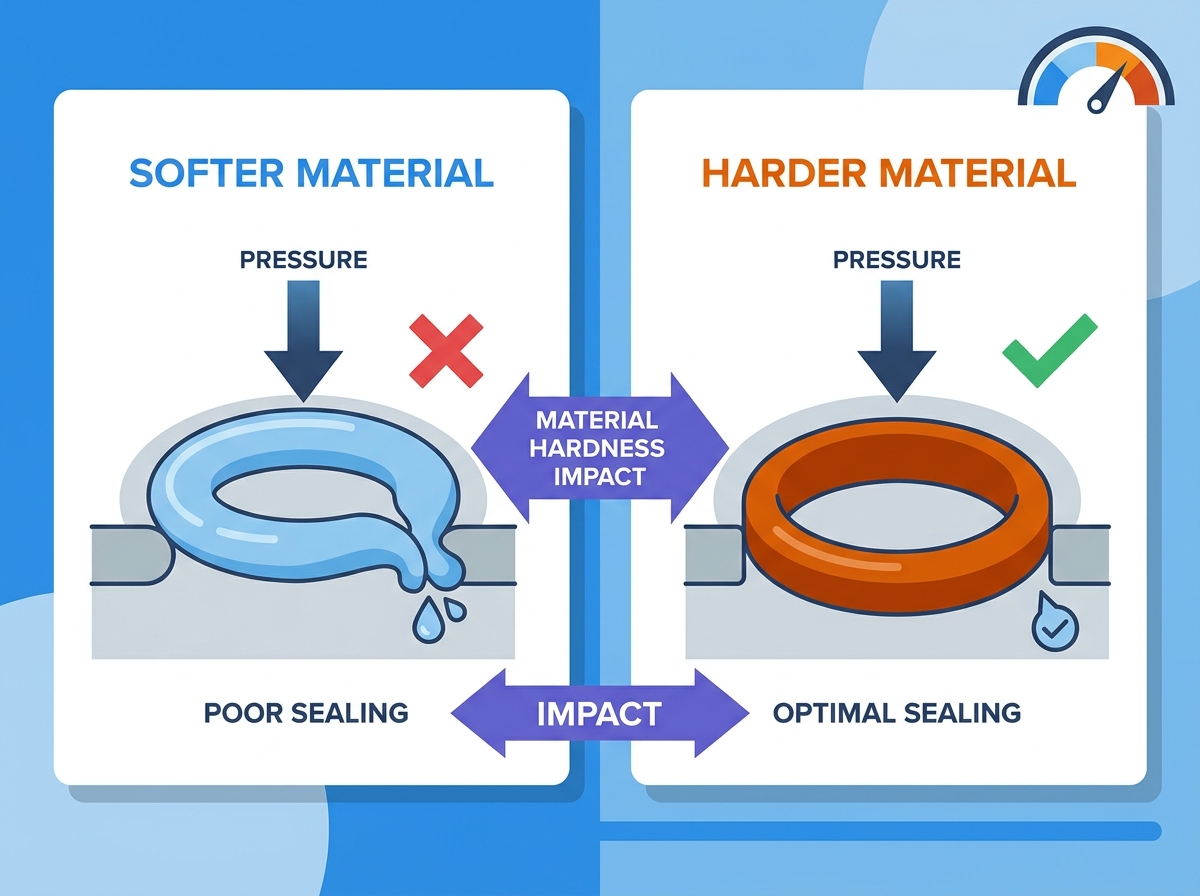
Dynamic application realities demand a careful analysis of breakout and running friction. In pneumatic or hydraulic cylinders, the seal constantly rubs against a moving shaft or bore. Hardness directly affects how much friction this movement generates. Higher durometer materials generally create less running friction because they do not deform as deeply into the hardware's surface profile. They ride on top of the microscopic peaks of the metal rather than sinking into the valleys.
While harder materials exhibit higher resistance to surface damage and abrasive wear, they present a different risk. A hard, glass-filled or highly cross-linked elastomer can cause accelerated wear on the mating hardware if the surface finishes are not optimized. The seal acts like a mild abrasive, slowly polishing or scoring the metal shaft over thousands of cycles. We have seen 90 Shore A seals completely ruin expensive chrome-plated cylinder rods because the hardware was not hardened sufficiently to handle the abrasive contact.
Conversely, softer compounds deform more under load. This deformation increases the surface contact area between the rubber and the metal. A larger contact area results in higher running friction, which generates excessive heat buildup. This localized heat can prematurely degrade the elastomer, causing it to harden, crack, and fail long before its expected lifespan. You must find the exact durometer that provides enough wear resistance without generating destructive friction.
Static face and radial seals remain stationary during operation. In these environments, extrusion resistance and compression set are the primary evaluation lenses. Since there is no movement to generate friction or abrasive wear, you can safely specify harder materials to maximize pressure capacity. The goal is to fill the gland, apply radial squeeze, and ensure the material does not extrude or take a permanent set over years of continuous compression. We default to 70 or 90 Shore A for static flanges depending entirely on the system pressure.
Dynamic seals, such as reciprocating or rotary applications, require a different approach. You must outline success criteria that balance hardness with lubricity and friction coefficients. If the material is too soft, it will grab the moving shaft, causing slip-stick effects and rapid tearing. If it is too hard, it may not maintain contact during slight shaft deflections. Dynamic applications often require an 80-durometer material to provide the right balance of wear resistance and flexibility.
Determine the maximum operating pressure to establish the baseline extrusion resistance required.
Calculate the maximum hardware clearance gap under full systemic load and thermal expansion.
Evaluate the surface finish of the dynamic hardware to ensure it will not rapidly abrade a softer elastomer.
Select a durometer that provides sufficient wear resistance without generating excessive running friction.
Test the selected compound in a physical prototype to verify breakout friction limits are not exceeded.
Standard 70 Shore A Acrylonitrile (NBR) or Fluorocarbon (FKM) seals are highly versatile. Yet, they present a significant failure risk in high-reliability applications like nuclear power plants, aerospace systems, and medical devices. In these environments, standard compounds are prone to accelerated thermal-oxidative degradation. The baseline assumption that a 70-durometer seal will perform adequately often leads to premature system failures when exposed to radiation or aggressive aerospace fluids. You cannot rely on catalog specifications for these environments.
Environmental factors cause post-curing or chemical cross-linking in the field. This aging process increases elastomer hardness and brittleness over time. A seal installed at 70 Shore A might age into a 95 Shore A material after two years of high-temperature service. This transformation leads to micro-cracking and a complete loss of sealing force. You must factor this lifetime reliability prediction into your initial material selection. We often specify a slightly softer initial durometer if we know the environment will cause the material to harden over its service life.

Elastomers become harder and less resilient at low temperatures. This cold temperature stiffening can cause a 70-durometer seal to act like a 90-durometer seal. When the material loses its elasticity, it cannot track hardware deflections or maintain radial squeeze. The seal shrinks away from the metal, causing immediate leakage until the system warms up. You must select compounds specifically formulated for low-temperature flexibility if your equipment operates in arctic or cryogenic conditions. Standard NBR will turn into a hard plastic puck at -40 degrees.
Elevated temperatures cause the opposite effect. High-temperature softening reduces the effective durometer of the rubber in real-time. A seal that measures 90 Shore A at room temperature might soften to 75 Shore A at 300°F. This softening increases the risk of extrusion in systems that are otherwise properly specified for pressure at ambient temperatures. You must evaluate the material's physical properties at the actual operating temperature, not just on the specification sheet.
Estimated Hardness Shift Across Temperature Extremes (Standard FKM) | |||
Operating Temperature (°F) | Nominal Hardness (Shore A) | Effective Field Hardness (Shore A) | Primary Failure Risk |
|---|---|---|---|
-20 | 75 | 85 - 90 | Loss of resilience, cold leakage |
75 (Ambient) | 75 | 75 | Baseline performance |
300 | 75 | 65 - 70 | Gap extrusion, nibbling |
400 | 75 | 60 - 65 | Catastrophic extrusion, permanent set |
Engineers constantly face the economic trade-off between machining costs and seal costs. Tightening hardware machining tolerances reduces the clearance gap, preventing extrusion and allowing the use of standard, inexpensive 70-durometer seals. However, precision machining is expensive and time-consuming. You have to weigh the cost of holding a two-thousandths tolerance on a large steel casting against the cost of upgrading the seal material.
Alternatively, you can specify a harder, potentially more expensive elastomer to bridge larger, loosely toleranced gaps. While a 90-durometer FKM seal costs more than a standard NBR seal, it might save thousands of dollars in manufacturing costs by allowing looser machining tolerances on heavy industrial castings. We frequently use 90 Shore A seals on large agricultural equipment specifically to avoid the high cost of precision machining massive hydraulic cylinders.
Specifying a material that is too hard introduces severe installation risks. Hard elastomers lack the stretch and flexibility required for easy assembly. Technicians risk tearing, nicking, or over-stretching these seals when forcing them over threads, splines, or into deep internal grooves. Once a hard seal sustains a microscopic nick during installation, it will almost certainly fail under pressure. You have to design the gland and the assembly tools to accommodate the lack of stretch in a 90 Shore A material.
Excessive hardness also leads to micro-leakage in low-pressure systems. Hard materials require substantial compressive force to deform. In a vacuum system or a low-pressure gas line, there is not enough systemic pressure to force the hard rubber into the microscopic surface asperities of the metal. The seal bridges across the scratches rather than filling them, creating a pathway for slow, persistent leaks. We never use 90 Shore A seals for vacuum applications for this exact reason.
When you specify a material that is too soft for the operating pressure, you invite nibbling and catastrophic extrusion. During pressure cycling, the soft rubber is repeatedly forced into the clearance gap and then pulled back as pressure drops. This physical degradation process tears small chunks of rubber from the seal. Over time, the seal loses its mass and fails completely, contaminating the hydraulic or pneumatic system with rubber debris. You will find the hydraulic filters clogged with black rubber particles when this happens.
Soft materials also pose significant blowout and Explosive Decompression (ED) risks. In high-pressure gas applications, gas permeates the cellular structure of the elastomer. When system pressure drops rapidly, the trapped gas expands instantly. A soft durometer material lacks the internal tear strength to contain this expanding gas. The rapid decompression tears the elastomer structure apart from the inside out, resulting in a blistered, destroyed seal. You must use high-durometer, specifically formulated ED-resistant compounds for high-pressure gas systems.
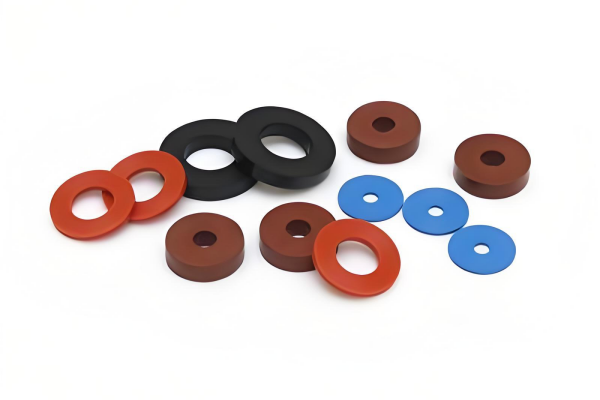
Hardness is just one variable in a complex chemical equation. You cannot treat all 70-durometer materials equally. A 70-durometer Nitrile (NBR) behaves entirely differently in its compression set, temperature range, and chemical resistance than a 70-durometer Fluorocarbon (FKM). The base polymer dictates the chemical compatibility and thermal limits, while the hardness dictates the mechanical extrusion resistance. You must evaluate both simultaneously. Specifying a 90 Shore A NBR for a high-temperature synthetic oil application will fail, not because of the hardness, but because the base polymer cannot handle the heat.
Off-the-shelf hardness ratings are sometimes insufficient for specialized applications. You must know when to engage manufacturers for custom durometer formulations. Custom compounding allows chemists to tweak the carbon black or silica fillers to achieve a specific hardness while maintaining strict regulatory compliance, low-temperature flexibility, or aggressive chemical resistance. Custom formulations bridge the gap when standard 70 or 90 Shore A options fail to meet rigorous operational demands. We rely on custom O-Ring compounds when dealing with mixed-phase fluids in the oil and gas sector.
Selecting the right O-ring hardness is essential for achieving reliable sealing performance across different pressure, temperature, and operating conditions. By balancing hardness with material properties and hardware design, manufacturers can reduce leakage, improve durability, and extend the service life of sealing systems.
Choosing an experienced sealing solutions provider is equally important for long-term performance. Cixi Lixu specializes in manufacturing high-quality O-Rings, customized sealing solutions, and precision rubber components for hydraulic, pneumatic, automotive, and industrial applications. With advanced production technology, rigorous quality control, and extensive engineering expertise, the company helps customers select the optimal sealing materials for reliable and long-lasting performance.
Consult with application engineers to verify your pressure-to-clearance ratios before finalizing hardware drawings.
Utilize extrusion clearance charts to determine the exact durometer required for your maximum system pressure spikes.
Request physical prototypes of different hardness levels to conduct compression and installation testing.
Evaluate the expected hardness shift by testing materials at your system's maximum and minimum operating temperatures.
A: The industry standard baseline is 70 Shore A. This hardness provides an optimal balance of flexibility, compression set resistance, and extrusion resistance for most general-purpose hydraulic, pneumatic, and fluid containment applications.
A: Higher system pressures force the elastomer into hardware clearance gaps. To prevent the material from extruding and tearing, high-pressure applications require harder compounds, typically 90 Shore A, which resist mechanical deformation.
A: A 70-durometer seal is softer, more flexible, and conforms easily to rough surfaces under low pressure. A 90-durometer seal is dense and rigid, requiring more compressive force but offering superior resistance to high-pressure extrusion.
A: Yes. If a seal is too hard, it may not deform enough to fill microscopic surface scratches, leading to micro-leaks in low-pressure systems. Hard seals are also difficult to install and can damage fragile mating hardware.
A: Extreme cold causes elastomers to stiffen and lose resilience, effectively increasing their hardness and causing leaks. Conversely, high temperatures soften the material, reducing its effective durometer and increasing the risk of pressure extrusion.
A: You can prevent extrusion by specifying a harder elastomer (e.g., 90 Shore A), tightening the machining tolerances to reduce the hardware clearance gap, or installing rigid backup rings alongside the primary seal.


